
The Most Commonly Overlooked Issue in Applications for Polish Citizenship and Permanent Residence: Your Trips Abroad
Travel abroad affects continuity for EU long-term residence, but the 6/10 rule, the Blue Card exception and permanent-residence rules must each be applied to the correct procedure.
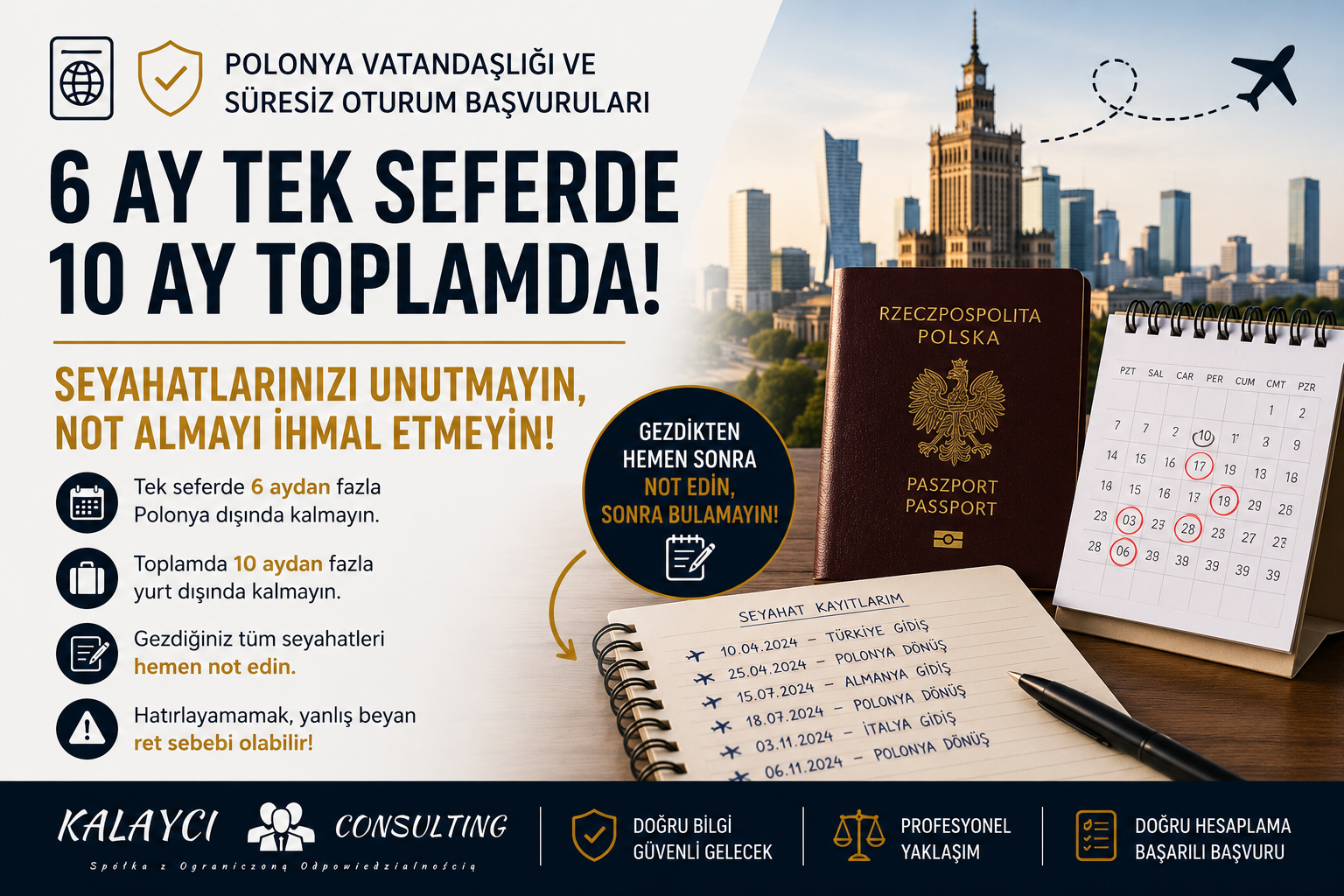
Update — legal status as of 22 August 2026: In the ordinary EULT calculation, the general limits are 6 months for a single absence and 10 months in total during the required five-year period. Statutory exceptions exist, and qualifying Blue Card cases may use 12/18-month limits. For citizenship, absences must be calculated separately under the relevant statutory route.
Many people planning to apply for Polish citizenship or Long-Term EU Residence (EULT) are keeping track of their residence periods, language requirements and income levels.
However, one of the most common issues encountered during the application process is often overlooked:
✈️ Overseas travel.
Recently, we have observed that many applicants are unable to recall trips they made years ago, have changed their passports, or cannot locate their old entry and exit records.
In some cases, incomplete or incorrect declarations can lead to serious problems.
What are the 6-Month and 10-Month Rules?
In the ordinary EU long-term resident (EULT) calculation, a single absence during the required five-year period should generally not exceed 6 months and all absences combined should not exceed 10 months. The statute provides justified-absence exceptions whose conditions must be checked separately. Qualifying Blue Card mobility may use limits of 12 months for one absence and 18 months in total; that exception does not automatically apply to ordinary applicants.
In citizenship proceedings, the EULT 6/10 rule is not a universal citizenship test. The period examined and continuity requirement depend on the particular statutory basis. All travel should therefore be recorded accurately and the calculation performed for the individual case.
The notion that ‘a few holidays don’t matter’ may be incorrect
Many people:
- summer holidays,
- family visits,
- business trips,
- short trips to Europe
are not significant.
However, years later, when applying for citizenship or an EU residence permit, you may need to recall all your entries and exits.
In particular:
✈️ Schengen travel
✈️ Non-Schengen countries
✈️ Passport changes
✈️ Lost old passports
can cause difficulties during the application process.
The Biggest Problem: “I Can’t Quite Remember”
We often hear the following statements during the application process:
- “I think I went in the summer of 2022.”
- “My old passport has gone missing.”
- “I can’t remember the exact dates.”
- “I might have stayed for about two weeks.”
Unfortunately, estimates made years later are not always accurate.
False Declarations Can Have Serious Consequences
It is extremely important that the information provided on application forms is correct.
Incomplete or incorrect travel details:
- requests for further clarification,
- delays in processing,
- trust issues,
- and, in some cases, to negative decisions
.
In particular, a finding that the applicant has knowingly provided false information may have serious consequences.
Best Practice: Take Notes Immediately Upon Returning from Your Trip
Our advice is quite simple:
📱 Make a note on your phone after every trip abroad.
For example:
- 10 July 2024 – Departure to Turkey
- 25 July 2024 – Return from Poland
or
- 15 March 2025 – Departure for business trip to Germany
- 18 March 2025 – Return from Warsaw
You can create a short list like this.
This habit, which takes just a few minutes, could prove very useful years down the line.
Don’t Forget to Keep Your Passports Safe
Old passports are also very important.
When you renew your passport:
✅ keep your old passports
✅ take photos of the entry and exit stamps
✅ File away your flight tickets and bookings
These documents may prove very useful in the future.
Preparation is Crucial for Citizenship and EULT Applications
When the application deadline approaches, many people:
- their past travel,
- departure dates,
- return dates
.
However, keeping accurate records saves time in the long run and reduces potential risks.
Our Advice at Kalaycı Consulting
If you are planning to apply for citizenship or permanent residence in Poland:
✅ Keep a regular record of your trips abroad.
✅ Keep your old passports.
✅ Make a note of your travel dates on your mobile phone.
✅ Have your eligibility calculations professionally checked before applying.
A small note taken today could make a big difference to your citizenship or permanent residence application years down the line.
Legal Basis and Official Sources
- Zezwolenie na pobyt rezydenta długoterminowego UE — Urząd do Spraw Cudzoziemców — MOS
- Zezwolenie na pobyt stały — Urząd do Spraw Cudzoziemców — MOS