
I’ve Been in Poland for 5 Years: Can I Apply for Long-Term EU Residence? How Are My Years as a Student Calculated?
One of the questions we are most frequently asked by foreigners who have been living in Poland for several years is: “It’s been five years since I arrived in Poland. Can I apply for permanent residence now?”
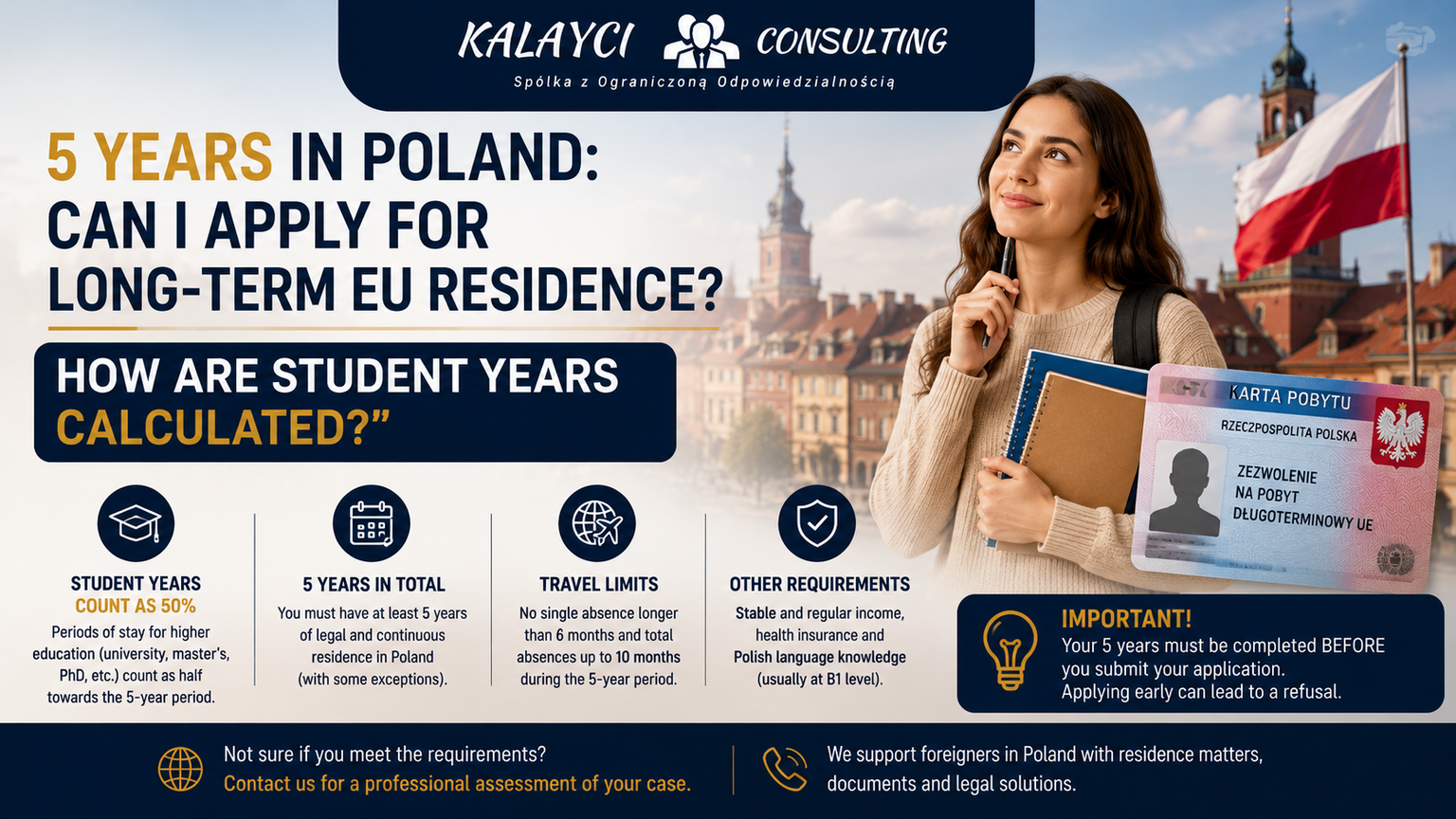
One of the questions we are most frequently asked by foreigners who have been living in Poland for several years is:
“It’s been five years since I arrived in Poland. Can I now apply for indefinite leave to remain?”
In particular, people who came to Poland to study at university and started working after graduating often make a simple calculation based on the calendar:
I arrived in Poland in 2021 → My five years will be up in 2026 → I can apply for Long-Term EU Residence.
However, unfortunately, the calculation isn’t always that straightforward.
Having been physically present in Poland for five years is not the same as having completed the full five-year period required for Long-Term EU Residence.
There is a particularly important rule when it comes to periods spent as a student:
Only half of certain legal periods of stay spent for the purpose of university education are taken into account.
Consequently, a person who has lived in Poland for five years as a university student will not automatically have five years counted towards their EULT.
In some cases, the calculated period may be as little as 2.5 years. Official sources from the Foreigners’ Office also clearly state that, in the example of five years spent solely as a student, the basic five-year requirement is not met.
Firstly: What is Long-Term EU Residence?
The Polish term is:
Zezwolenie na pobyt rezydenta długoterminowego Unii Europejskiej
is a long-term residence status granted to third-country nationals provided they meet certain conditions.
In everyday language, this is referred to as:
- EULT,
- EU Long-Term Resident,
- EU long-term resident,
- permanent residence
.
The permit itself is permanent.
However, the physical residence card issued after the permit is granted is valid for 5 years and is renewed thereafter. In other words, the fact that the card is valid for 5 years does not mean that your right of residence is limited to just 5 years.
Key Rule: The 5-Year Period Must Be Completed Before Applying
One of the key conditions of the EULT is that the foreign national must have resided in Poland legally and continuously for at least 5 years immediately prior to their application, in accordance with the requirements of the law. For Blue Card holders, there are also specific intra-EU calculation rules.
Please pay particular attention to the phrase ‘prior to the application’ here.
This should not be confused with certain differing interpretations that may arise in citizenship procedures.
You cannot wait until after submitting your application to complete the five years required for the EULT.
For example, according to your calculations:
if your five years are due to be completed on 15 December 2026,
it is incorrect to apply in August 2026 thinking, “The application process will take a year anyway”.
You must have met the required period of residence by the date of application.
For this reason, even applying a few months early for an EULT application can carry the risk of rejection.
Don’t we count the five years from the date I arrived in Poland?
Not always.
When calculating the EULT, it is not enough to simply ask:
“When did you first arrive in Poland?”
The key questions are:
When were you in Poland, and on what legal basis were you staying during each period?
This is because not all types of legal residence in Poland are calculated in the same way.
Some periods:
100 per cent
are taken into account.
Others:
50
is taken into account.
In some periods, however:
is not taken into account at all.
MOS also specifically emphasises that the five-year calculation is unusual and that the legal basis for the stay is the determining factor.
How is time spent as a university student calculated?
This is the most commonly misunderstood issue.
In Poland:
- undergraduate degree (studia pierwszego stopnia),
- master’s degree (studia drugiego stopnia),
- integrated master’s degree (jednolite studia magisterskie),
- doctoral programme (doctoral school)
and other periods of stay spent for the purposes of higher education, as specified by law, are counted as half-periods for EULT calculations.
The MOS explicitly states that the five-year period taken into account for employment purposes
explicitly states that half of the time spent under certain visas issued for educational purposes and half of the time spent under certain temporary residence permits issued for such purposes are included.
Put simply:
2 years as a student = approximately 1 year in the EULT calculation
4 years as a student = approximately 2 years in the EULT calculation
5 years as a student = approximately 2.5 years in the EULT calculation
However, the exact calculation must always be based on the individual’s visa and residence history.
Example 1: I was a student in Poland for 5 years
Ali went to Poland:
1 October 2021
for the purpose of university studies.
On 1 October 2026, his period of physical residence in Poland:
5 years.
Ali thinks:
“I’ve been in Poland for 5 years, so I can apply for the EULT.”
However, if the entire 5-year period has been spent under a relevant student visa and student residence permit, this period will generally be counted as half in the EULT calculation.
Physical residence:
5 years
For EULT purposes:
approximately 2 years 6 months
Therefore, only:
“I have been living in Poland for 5 years.”
is not sufficient.
The FAQ section on the Wielkopolski Provincial Office’s current EULT page also directly answers the question “I have studied in Poland for 5 years; can I apply?” by stating that the 5-year requirement is not met because only half of the period spent as a student is counted.
Example 2: 3 Years of Study + 2 Years of Work
Mehmet:
He has been living in Poland
in Poland.
He then graduates and:
continues to live in Poland
.
Simplified calculation:
Study period:
3 years × 50 per cent = 1.5 years
Work:
2 years × 100 per cent = 2 years
Total in terms of EULT:
3.5 years
Mehmet has been physically present in Poland for:
for 5 years
.
However, in the EULT calculation, he has so far:
3 years and 6 months
.
In this case, the basic 5-year period has not yet been completed.
Example 3: 2 Years of Study + 4 Years of Work
Ayşe in Poland:
2 years as a student
and then:
4 years as a worker
.
Simplified calculation:
Student years:
2 years × 50 per cent = 1 year
Employment:
4 years × 100 per cent = 4 years
Total:
5 years
Ayşe’s actual length of stay in Poland:
6 years
, the period calculated for EULT purposes amounts to only approximately 5 years.
This example clearly illustrates why many former students are unable to apply for the EULT exactly in their fifth year of physical presence in Poland.
I Came as a Student but Then Started Working
The calculation made here:
“I was a student but I was also working, so that period should count as 100 per cent.”
is not how it works.
In the EULT calculation, it is not just whether you were working or not that matters.
The legal basis for your stay is what matters.
For example, as a full-time student, you may have had the right to work without a work permit.
However, this situation does not automatically convert your residence permit, granted for student purposes, into a work-based residence permit.
Therefore:
“I worked for three years whilst at university and my ZUS contributions were paid.”
does not, on its own, mean that the full three years will be counted towards your EULT.
Are Student Visas Also Counted as Part-Time?
Yes, in the case of certain visas issued for educational purposes.
The MOS clearly states that half of the time spent in Poland on the basis of a visa issued for the purpose of university education, doctoral studies or vocational training is included in the five-year calculation.
Therefore, it is also incorrect to make calculations based solely on the card.
In a person’s history:
- a D-type visa,
- a student residence card,
- a work residence card,
- or another legal basis for residence
may be present.
The EULT calculation must be carried out by examining all these periods individually in chronological order.
‘Nauka’ and ‘Studia’ Are Not the Same Thing
This distinction is particularly important.
Under Polish immigration law, stays that might all be referred to as ‘student status’ in everyday Turkish may not fall into the same legal category.
For example:
studia
and
nauka
do not fall under the same legal category.
Whilst MOS states that half of certain ‘studia’ periods are taken into account, it explicitly states that certain ‘nauka’-based stays may not be included in the five-year period at all.
Therefore:
“I was studying at school, so half of that time counts.”
is not necessarily true in every case.
First, one must consider the legal purpose for which your visa or residence permit was granted.
This distinction may be particularly important for types of education other than post-secondary school, language courses and higher education.
Is the duration of a ‘szkoła policealna’ counted as half?
To put it simply:
“Every ‘szkoła policealna’ term counts as 50 per cent.”
is not correct.
This is because the legal basis for your stay must again be taken into account.
According to the MOS’s explanation, whilst certain education-based temporary residence periods are not included in the five-year calculation at all, certain visas and residence periods specified in the law for the purposes of university, doctoral or vocational education are counted as half.
Therefore, calculations should not be based solely on the name of the school.
Count Your Trips Before Saying “My 5 Years Are Up”
For the EULT, not only the total duration but also the requirement for uninterrupted residence is important.
However, the term ‘uninterrupted’ means:
does not mean that you cannot leave Poland at all
.
As a general rule, travel within certain limits does not interrupt the continuity of residence.
According to the standard rules set out by the MOS, as a general rule, a single stay outside Poland must not exceed 6 months, and the total duration of stays abroad within a 5-year period must not exceed 10 months. The law also provides for exceptions in certain special and justified circumstances.
Therefore, in your EULT account, you should only enter:
“What was my date of first entry?”
We do not look at this question alone.
We also take into account all:
- trips to Turkey,
- holidays,
- long stays abroad,
- and periods spent in other countries
should also be checked.
Don’t Forget the 6-Month / 10-Month Rule
Two very important figures in the standard EULT calculation:
In a single period: 6 months
In total: 10 months
However, as there may be legal exceptions in certain special cases, it is not correct to apply these figures mechanically to all cases.
Our advice, particularly for those who have been living in Poland for many years:
Keep a record of all your trips abroad.
Because 5–7 years on, it may be much harder than you think to recall old flights, land border crossings or short holidays.
So, is the expiry of the 5-year period sufficient on its own?
No.
This is also very important.
EULT only accepts:
“I have completed five years.”
It is not an application based solely on that.
In addition to five years’ eligible and uninterrupted residence, there are other conditions.
Foremost among these is:
a stable and regular income,
health insurance,
and
knowledge of Polish
.
How is the Income Requirement Assessed?
In standard applications, it is not sufficient for your salary to be adequate only for the month in which you apply.
According to MOS’s current guidance, the requirement for a stable and regular income is assessed, in standard cases, for the three-year period prior to the application and also whilst the application is being processed. In certain special cases relating to the Blue Card, this period may be two years.
Therefore:
“I’ve just started work this month and my salary is high, so I can apply for the EULT.”
is not always sufficient.
Your income history must also be examined.
Is there a Polish B1 language requirement?
Knowledge of Polish is also one of the key requirements for an EULT application.
However, this requirement simply means:
“You must sit the B1 state exam.”
It should not be interpreted in this way.
There are various methods of proving Polish language proficiency recognised by the regulations.
Therefore, a person’s:
- educational background in Poland,
- their diploma,
- Polish language certificate
should also be taken into account.
MOS also explains that the documents certifying knowledge of Polish are determined in accordance with the relevant legislation.
What if I am still on a student visa at the time of application?
There is another very important point here.
According to MOS’s current statement, individuals who are in Poland for educational purposes at the time of application are not eligible to receive an EULT permit.
In other words, the fact that you were previously a student is not a problem; those periods may be taken into account subject to certain rules.
However:
Your residence status at the time you submit your EULT application is also important.
Therefore:
“I have completed five years on my record but still hold a student residence card.”
This situation must be assessed separately.
Do Not Confuse This with Citizenship: Do Not Apply for the EULT Early
This is a particularly important point.
Some people have heard regarding citizenship procedures:
“The conditions can be met by the decision date.”
and try to apply this to the EULT.
This is incorrect.
For the EULT, the MOS explicitly refers to the required residence period of at least five years immediately prior to the application.
For example:
Completion date of your EULT application:
20 November 2026
,
you cannot apply on 25 August 2026 and say, ‘I’ll have completed the five years by the time a decision is made anyway’.
The condition will not yet have been met on the date of application.
Therefore, applying a few months early may lead to your application being rejected rather than speeding up the process.
How Do We Calculate Your Actual EULT Date?
We do not simply take the date of first entry into Poland from a file and add five years to it.
For example, the person’s history should be broken down as follows:
01.10.2020 – 30.09.2021 Student D visa
01.10.2021 – 30.09.2023 Student residence permit
01.10.2023 – 30.09.2026 Work residence permit
Then, for each period, in terms of EULT:
we check whether it is calculated as 100 per cent, 50 per cent or 0 per cent
we check how it is calculated.
We then examine any travel outside Poland.
Finally, we check income, insurance, Polish language proficiency and the current residence status at the time of application.
Only then:
“You can apply for the EULT from this date onwards.”
it becomes safe to say.
Common Mistakes
In EULT applications, we particularly encounter the following errors:
- Adding five years directly to the date of first entry into Poland.
- Assuming that the entire duration of your studies is counted.
- Assuming that the student residence permit will be calculated at 100 per cent by stating, ‘I was working whilst I was a student’.
- Failing to take into account the difference between ‘studia’ and ‘nauka’.
- Failing to examine visa periods at all.
- Failing to take into account travel outside Poland.
- Overlooking the requirement that the five-year period must be completed by the application date.
- Focusing solely on the length of residence without checking the income, insurance and Polish language requirements.
Five Years Physically in Poland ≠ Five Years for the EULT
This is the most important sentence to remember from this article:
Having lived in Poland physically for 5 years may not mean that your 5 years for EULT purposes have been completed.
Particularly for those who came to Poland as students, the actual EULT date may be much later than the fifth year of physical residence.
For example:
4 years as a student + 3 years working
means a total of:
7 years
in Poland.
However, in the simplified EULT calculation:
4 years of study → 2 years
3 years’ employment → 3 years
Total → 5 years
may apply.
In other words, by the time a person physically reaches their 7th year in Poland, they may have completed the calculated 5-year period required for EULT.
Our Advice at Kalayci Consulting
One of the biggest mistakes in applying for Long-Term EU Residence is miscalculating the application date.
Particularly if you have a history of:
- a student visa,
- a student residence permit,
- post-secondary school,
- work residence permit,
- graduate residence permit,
- visas issued for various purposes,
- long-term stays abroad
if any, do not base your calculations solely on the calendar.
Each period must be assessed separately.
Because, from the EULT’s perspective:
one year is not always equivalent to one year.
Some periods count as a full year.
Some are counted as half.
Others are not counted at all.
And most importantly:
The required five-year period must have been completed by the date you submit your application.
Do not submit your application early with the thought that ‘the process is already taking a long time, so I’ll complete it by the time a decision is made’.
If five years have passed since your arrival in Poland, first determine your actual EULT calculation date; then check the other conditions and prepare your application.
Kalayci Consulting – This content has been prepared for general information purposes. The EULT calculation may vary depending on an individual’s visa types, residence decisions, travel history and other personal circumstances. The case must be assessed on an individual basis prior to application.
Legal Basis and Official Sources
- Uzun Dönem AB Oturumu – 5 Yıllık Yasal ve Kesintisiz İkamet Şartı — Urząd do Spraw Cudzoziemców – Moduł Obsługi Spraw (MOS)
- EULT Hesabında Öğrencilik Sürelerinin %50 Olarak Hesaplanması — Urząd do Spraw Cudzoziemców – Moduł Obsługi Spraw (MOS)
- Ustawa o cudzoziemcach – Art. 212: EULT İkamet Süresinin Hesaplanması — Elektroniczny Dziennik Ustaw (ELI)
- Polonya’da 5 Yıl Öğrencilik EULT İçin Yeterli Mi? – Resmî Açıklama — Wielkopolski Urząd Wojewódzki w Poznaniu