
I’ve Married a Polish National: When Can I Obtain Permanent Residence and Polish Citizenship?
One of the most common questions we receive from foreigners who have married a Polish citizen is: “I’ve got married – when can I obtain indefinite leave to remain?” This is immediately followed by: “So when can I become a Polish citizen?” There is a great deal of misinformation on this subject online. “You can obtain citizenship three years after marrying a Polish person.”
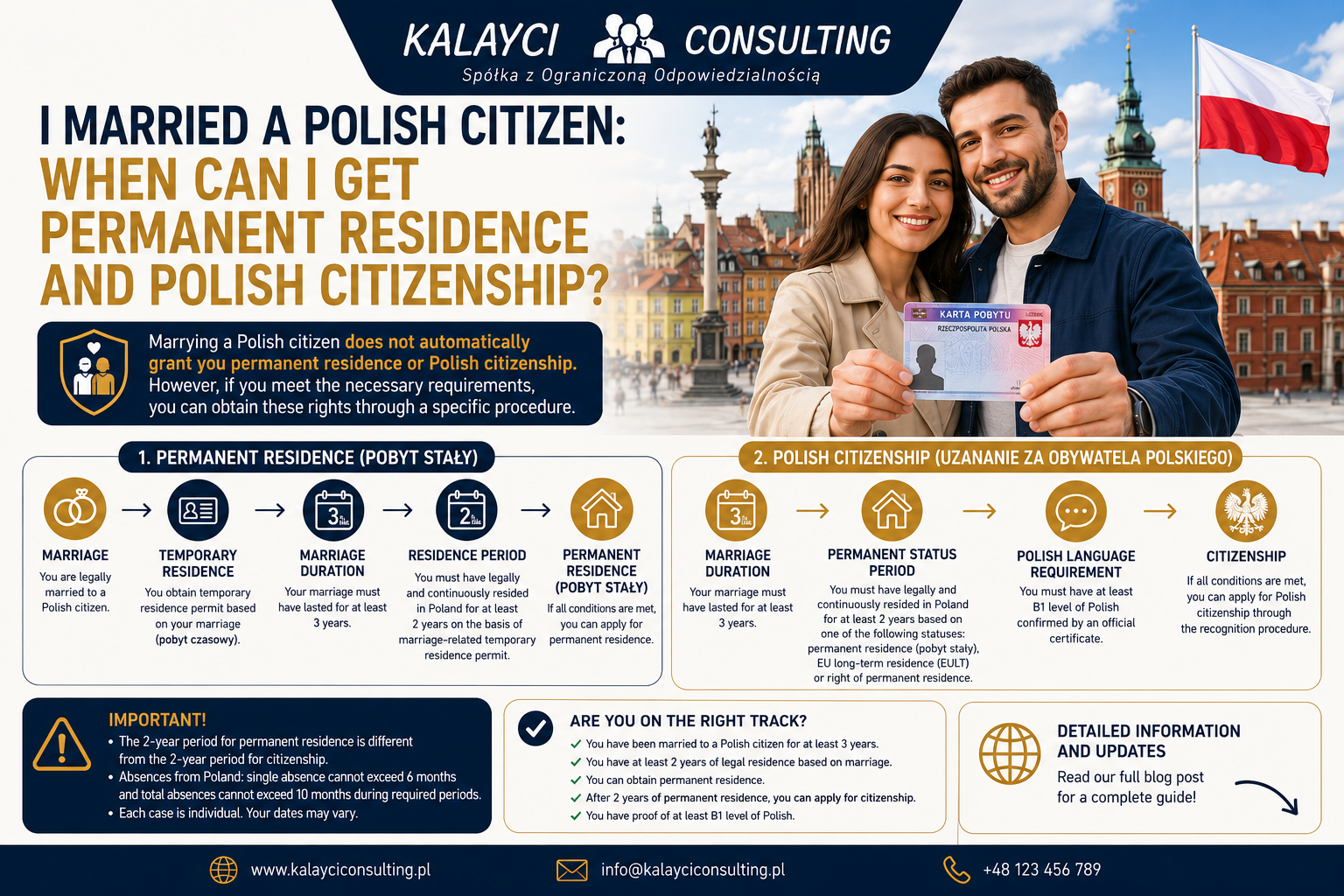
One of the questions we are most frequently asked by foreign nationals who have married a Polish citizen is:
“I’ve got married – when can I apply for indefinite leave to remain?”
And immediately after that:
“So when can I become a Polish citizen?”
There is a great deal of misinformation on this subject online.
“You can obtain citizenship three years after marrying a Polish person.”
“You can obtain indefinite leave to remain after two years of marriage.”
“You automatically become a citizen five years after getting married.”
None of these statements, on their own, is entirely accurate.
This is because, under Polish law, the duration of the marriage, the type of residence permit under which you are living in Poland, and the length of time you have spent on that permit are all important factors in their own right.
Let’s start with the basic rule:
Marrying a Polish citizen does not automatically grant you Polish citizenship or the right to permanent residence.
However, provided you meet the necessary conditions, there is a special route available through your Polish spouse leading to both permanent residence (pobyt stały) and, subsequently, Polish citizenship (uznanie za obywatela polskiego).
Stage One: I’ve Married a Polish Citizen – What Happens Next?
A foreign national who has entered into a legally valid marriage with a Polish citizen may, provided they meet the necessary conditions, apply on the basis of their spouse for:
a temporary residence permit for a family member of a Polish citizen
that is, a temporary residence permit on the grounds of marriage to a Polish citizen.
The key point here is:
Marriage does not automatically lead to permanent residence.
In most standard cases, there is first a temporary residence phase linked to the marriage.
To obtain permanent residence, certain time requirements must also be met.
When Can Permanent Residence Be Obtained Through Marriage to a Polish Citizen?
Through marriage to a Polish citizen:
permanent residence permit
— that is, to obtain a permanent residence permit — two key time-based requirements must be met simultaneously.
1. Your marriage must have lasted for at least three years.
AND
2. Immediately prior to the application, you must have lived in Poland continuously for at least 2 years under a temporary residence permit granted on the basis of your marriage to a Polish citizen.
MOS clearly states that these two conditions must be met together.
In short, the formula is simply:
A marriage of at least 3 years + a temporary residence permit based on marriage for at least 2 years
However, it is important not to confuse these two periods.
‘I’ve Been Married for 3 Years’ Is Not Sufficient on Its Own
For example, Ahmet is married to a Polish national:
1 September 2023
.
On 1 September 2026, their marriage will have lasted exactly:
3 years
will have passed.
However, Ahmet’s:
“My three-year marriage requirement has been met; I can now apply for permanent residence.”
is not sufficient on its own.
He must also have completed the required two-year period of eligible residence immediately prior to the application.
So, when does this two-year period begin?
This is one of the points where mistakes are most commonly made.
These two years:
❌ do not automatically start from the wedding date,
❌ do not automatically start from the date of first entry into Poland,
❌ does not include any period spent on any type of residence permit.
The period required for the standard route to permanent residence via a spouse is a minimum of two years’ uninterrupted residence in Poland on a temporary residence permit granted immediately prior to the application, on the grounds of marriage to a Polish citizen. The law also provides for special alternatives such as refugee status, subsidiary protection and residence on humanitarian grounds.
Very Important Example: I Had a Work Residence Permit
Let’s assume that Mehmet had a residence card in Poland for work purposes.
Mehmet:
He married a Polish citizen on 1 January 2023.
However, he continued to use his work residence card.
Later:
On 1 January 2025,
he was granted a temporary residence permit on the basis of his Polish spouse.
Mehmet:
On 1 January 2026,
he will have been married for three years.
However, the valid period of the temporary residence permit granted through his spouse is only:
1 year
under the appropriate temporary residence permit granted through his spouse.
Consequently, the second requirement for the standard permanent residence permit via a spouse has not yet been met.
In this example:
the three-year marriage requirement has been met.
However:
The requirement for a two-year temporary residence permit based on marriage has not been met.
For this reason, they cannot yet apply for permanent residence on this basis.
“But I’ve Been Living in Poland for 7 Years Anyway”
This alone does not change the outcome.
Special conditions apply for permanent residence through a spouse.
For example, if a person:
- 4 years on a student residence permit,
- 2 years on a work permit,
- 1 year on a spousal residence permit
may have lived in Poland for a total of 7 years.
However, the required 2-year period of eligible temporary residence for permanent residence through marriage may not yet have been completed.
Of course, if the person’s background entitles them to permanent residence via another route or the EULT scheme, that option will also be considered.
Marriage is not the only option.
Example: When Are the Conditions Met?
Ayşe, married to a Polish national:
10 June 2024
.
Her temporary residence permit on the grounds of marriage was issued on:
15 November 2024
.
The third year of the marriage:
10 June 2027
.
The two-year period for temporary residence based on marriage is:
15 November 2026
.
The date on which both conditions are met simultaneously:
10 June 2027
.
Therefore, in this simplified example, the critical date for permanent residence is the third wedding anniversary.
The opposite may also be the case
In another example, the marriage may have been ongoing for a long time, but the couple may have been living outside Poland.
For example:
You got married in 2022.
You moved to Poland in 2026.
You have now been married for four years.
“I’ve already met the three-year requirement, so I’ll get permanent residence straight away.”
You cannot say this.
This is because you must also have completed the required two-year period of eligible residence in Poland immediately prior to your application.
The Wielkopolski Provincial Office’s current FAQ gives exactly this example: it explains that a person who has been married to a Polish citizen for more than three years but has been living abroad until now cannot obtain a pobyt stały straight away; they must first complete the required two years on a temporary residence permit based on marriage in Poland.
Once You Obtain Permanent Residence, Is It Then Indefinite?
Yes.
A zezwolenie na pobyt stały is not granted for a specific period; the permit is indefinite.
However, the physical residence card is renewed at regular intervals.
Here:
the duration of the right of residence
and
the validity period of the plastic card
must be distinguished from one another.
Renewing the card does not mean that a new permanent right of residence must be obtained from scratch each time.
So, when can Polish citizenship be obtained?
We now move on to the second stage.
The standard administrative route to citizenship through marriage to a Polish citizen:
uznanie za obywatela polskiego
that is, the procedure for being recognised as a Polish citizen.
Here, too, there are two important timeframes.
Under Polish citizenship legislation, a foreign national must:
have been married to a Polish citizen for at least three years
AND
have been living in Poland continuously for at least two years on the basis of pobyt stały, EULT or prawo stałego pobytu
.
This is the second ‘two years’ that people most commonly get confused about.
So, is it 2 years for permanent residence plus another 2 years for citizenship?
In the standard scenario, yes; in practice, such a sequence may arise.
Because for permanent residence through a spouse:
3 years of marriage + 2 years of eligible marriage-based temporary residence
is required, whilst
for citizenship via this specific marriage route:
3 years of marriage + 2 years of permanent residence / EULT / right of permanent residence
are required.
Therefore:
the 2 years spent on a temporary residence permit are not the same as the 2-year period of permanent status required for citizenship.
Let’s Draw Up a Simple Timeline
For example, a foreign national:
Married a Polish citizen on 1 January 2026.
They also obtained a temporary residence permit on the basis of marriage and completed the necessary periods.
1 January 2029
The marriage reaches its third year.
If, at the same time, the required minimum period of at least two years’ uninterrupted residence under the marriage-based temporary residence permit has been completed:
➡️ An application for permanent residence may be possible.
Let’s say that permanent residence is subsequently granted.
The specific two-year period required for citizenship is:
begins to be counted
.
Once two uninterrupted years have been completed under this status, and provided the other conditions are met:
➡️ An application for citizenship via ‘recognition as a Polish citizen’ may be considered.
Can we say, ‘Then I’ll become a citizen exactly five years after getting married’?
No, we cannot state a definite date.
Theoretically, in some cases, the process may follow a timeline close to this.
However, in reality:
- the date on which the first residence permit based on marriage came into effect,
- when the two-year period ends,
- when an application for permanent residence can be made,
- when the decision on permanent residence is issued,
- when the required two-year period for permanent status is completed,
- and
may affect the final date.
Therefore:
“Automatic citizenship five years after marrying a Polish national.”
There is no such rule.
Very Important: The Two-Year Period for Citizenship Is Not Counted from the Wedding Date
The two-year period required for this route to citizenship:
permanent residence / EULT / right of permanent residence
must be spent.
For example:
You have been married for 8 years.
However, your permanent residence permit was only granted:
6 months ago
.
The fact that you have only been married for 8 years does not mean that the 2-year permanent residence requirement for this specific route to citizenship is waived.
Don’t Forget the Polish B1 Requirement
In the case of citizenship by recognition as a Polish citizen, marriage and residence periods alone are not sufficient.
Generally, knowledge of Polish at least at B1 level must also be proven by an official document recognised by the legislation. The MSWiA’s current citizenship guide clearly states this.
The types of documents accepted by the law must also be checked.
In particular, as there have been legislative changes regarding the ‘szkoła policealna’ diploma with effect from 2026, one should not rely on older online articles. The latest statement from the Lower Silesian Provincial Office, dated May 2026, also draws attention to these changes in the rules regarding language certificates.
Is There an Income Requirement for Citizenship by Marriage?
There is a significant advantage here.
Under Article 30(1)(2)(a) – that is, the route involving at least three years’ marriage to a Polish citizen plus at least two years’ permanent residence status – does not, unlike the general three-year route under point 1, require a stable income or the right to housing. The official MSWiA guide also lists the two criteria separately.
However, this does not mean that the rest of the application will not be examined.
The Marriage Must Be Genuine
A marriage to a Polish citizen must not be a relationship entered into solely for the purpose of obtaining citizenship or residence on paper.
During the residence permit process, the authorities may assess the authenticity of the marriage.
In this context:
- cohabitation,
- a shared life,
- getting to know one another,
- the history of the relationship,
- a shared address,
- family life
and similar factors may be examined.
Consequently, the mere existence of a marriage certificate is not sufficient in every case.
Can an interview be conducted?
Yes.
Particularly in residence applications based on a first marriage, the Foreigners’ Office may summon spouses for an interview.
Questions:
- how you met,
- when you decided to get married,
- where you live,
- your daily life,
- your families,
- the history of your relationship
and so on.
The aim is to assess whether the marriage was genuinely entered into with the intention of establishing a family life.
Overseas Travel is Also Important
The concept of uninterrupted residence is important for both permanent residence and the subsequent citizenship stage.
As a general rule, during the period required for permanent residence through a spouse, a single stay outside Poland must not exceed six months, and the total duration of stays abroad during the relevant period must not exceed ten months; there are certain exceptions provided for in the law. The Podlasie Provincial Office explains this clearly in its current guidance.
Therefore, years later:
“On what dates did I travel to Turkey?”
it is far safer to keep a record of all your travels from now on, rather than having to search for old tickets.
What Happens If My Spouse and I Get Divorced?
The answer to this question depends on the stage the case is at.
If you are still holding a temporary residence permit on the basis of marriage, a divorce could directly affect the basis of your residence permit.
If you are at the stage of applying for permanent residence or citizenship, different rules may apply.
In particular, the special condition for citizenship through marriage requires the applicant to have been married to a Polish citizen for at least three years.
For this reason, cases involving divorce must be assessed on a case-by-case basis.
Is a Work Permit Required When Marrying a Polish Citizen?
Marriage to a Polish citizen and the associated residence status may also have significant implications regarding the right to work.
However, simply stating:
“I am married to a Polish national.”
should not be taken as grounds for assuming the right to work.
The individual’s current legal basis for residence and the type of residence permit they hold must also be checked.
Are Permanent Residence and EULT the Same Thing?
No.
Permanent residence versus:
the EU Long-Term Resident Permit (EULT)
are two different legal statuses.
Marriage to a Polish citizen may, provided certain specific conditions are met, directly constitute a legal basis for a permanent residence permit.
An EULT, on the other hand, is a separate procedure generally subject to different requirements regarding residence, income, insurance and language proficiency.
However, on the path to citizenship, both permanent residence and EULT are among the statuses recognised as leading to permanent residence.
Citizenship by Presidential Decree is Different
Let us add one more important distinction here.
The route to citizenship described in this article:
Recognition as a Polish citizen
that is, the procedure for being recognised as a citizen in accordance with the conditions laid down by law.
Apart from this:
The granting of Polish citizenship by the President of the Republic of Poland
that is, a different procedure whereby Polish citizenship is granted by the President of the Republic of Poland.
The legal framework for these two routes is not the same.
Consequently, on the internet:
“You must have two years of permanent residence to obtain citizenship.”
such statements should not be interpreted as a general rule applicable to all routes to citizenship.
The timeframes mentioned in this article specifically relate to the route of ‘uznanie za obywatela polskiego’ via a Polish spouse.
Common Mistakes
In these cases, we particularly encounter the following misconceptions:
- “I’ve married a Polish national, so I can get permanent residence straight away.”
- “I’ve been married for three years, so I’m now automatically entitled to indefinite residence.”
- Confusing the time spent on a work or student residence permit with the two-year marriage-based residence period required for a permanent residence permit through a spouse.
- Assuming that the two-year period required for permanent residence is the same as the two-year period of permanent status required for citizenship.
- Thinking, “I’ll automatically become a citizen five years after getting married.”
- Forgetting the Polish language B1 requirement for citizenship.
- Failing to keep a record of overseas travel.
A Simplified Timeline
If we simplify the typical route for a standard third-country national applying through their spouse:
💍 MARRIAGE
A legally valid marriage to a Polish citizen.
↓
🪪 TEMPORARY RESIDENCE BASED ON MARRIAGE
A ‘pobyt czasowy’ (temporary residence permit) subject to the necessary conditions.
↓
⏳ FOR PERMANENT RESIDENCE
A marriage of at least 3 years’ duration
At least 2 years’ valid temporary residence based on marriage immediately prior to the application
↓
🇵🇱 PERMANENT RESIDENCE
Permanent residence, provided the conditions are met.
↓
⏳ FOR CITIZENSHIP
Marriage of at least 3 years’ duration
At least 2 years’ uninterrupted permanent residence / EULT / right of permanent residence
Required knowledge of Polish
↓
🇵🇱 RECOGNITION AS A POLISH CITIZEN
Application for Polish citizenship if the conditions are met.
The answer to the question ‘When can I apply?’ is not the same for everyone
Two people may have married Polish citizens on the same day, but the dates of their applications for permanent residence and citizenship may differ.
This is because one of them:
- may already have a valid status in Poland,
- the other’s marriage-based residence may have commenced much later,
- one may have spent a long time abroad,
- the other may have had a different status, such as EULT.
For this reason, it is not possible to calculate the exact date of citizenship based solely on the date of marriage.
Our Advice at Kalayci Consulting
If you have married a Polish citizen, the process is:
“Wait 3 years → become a citizen”
Do not think of the process in these terms.
In fact, there are two separate timeframes at play:
First criterion: The duration of your marriage
Second criterion: How long you have been living in Poland under which residence status
At the permanent residence stage, the requirements for both these ‘clocks’ must be met simultaneously.
At the citizenship stage, however, a new critical period comes into play: at least two years’ uninterrupted residence under the status of ‘pobyt stały’ / EULT / ‘prawo stałego pobytu’.
Therefore, choosing the correct residence status from the moment you marry a Polish citizen can directly affect the date on which you will eventually obtain citizenship.
In short:
Marriage does not automatically confer permanent residence.
3 years of marriage does not, on its own, constitute ‘pobyt stały’.
Obtaining permanent residence does not automatically lead to citizenship.
The 2 years required for citizenship do not include the 2 years spent on temporary residence based on marriage.
However, once you have correctly calculated the periods spent under the correct status, the path to permanent residence and subsequently citizenship through a Polish spouse becomes quite clear.
Kalayci Consulting – This article has been prepared for general information purposes. In particular, an individual’s current residence status, date of marriage, the start date of their marriage-based residence permit, travel history and other individual circumstances may affect the application date.
Legal Basis and Official Sources
- Polonya Vatandaşı Eşi İçin Daimi Oturum – 3 Yıl Evlilik ve 2 Yıl Oturum Şartı — Urząd do Spraw Cudzoziemców – Moduł Obsługi Spraw (MOS)
- Polonya Vatandaşıyla Evlilik Üzerinden Vatandaşlık – Uznanie za Obywatela Polskiego — Świętokrzyski Urząd Wojewódzki w Kielcach
- Ustawa o obywatelstwie polskim – Art. 30: Polonya Vatandaşı Olarak Tanınma Şartları — Elektroniczny Dziennik Ustaw (ELI)
- Polonya Vatandaşı Eşi İçin Daimi Oturum – Kesintisiz İkamet ve Yurtdışı Süreleri — Podlaski Urząd Wojewódzki w Białymstoku