
Changes to Polish Citizenship Requirements: What Does the 2026 Bill Entail?
An important development has taken place that is of particular interest to foreign nationals who have been living in Poland for many years and are planning to apply for Polish citizenship. On 27 October 2026, the Polish government placed a new draft bill on the official legislative agenda, aimed at significantly amending the conditions for citizenship.
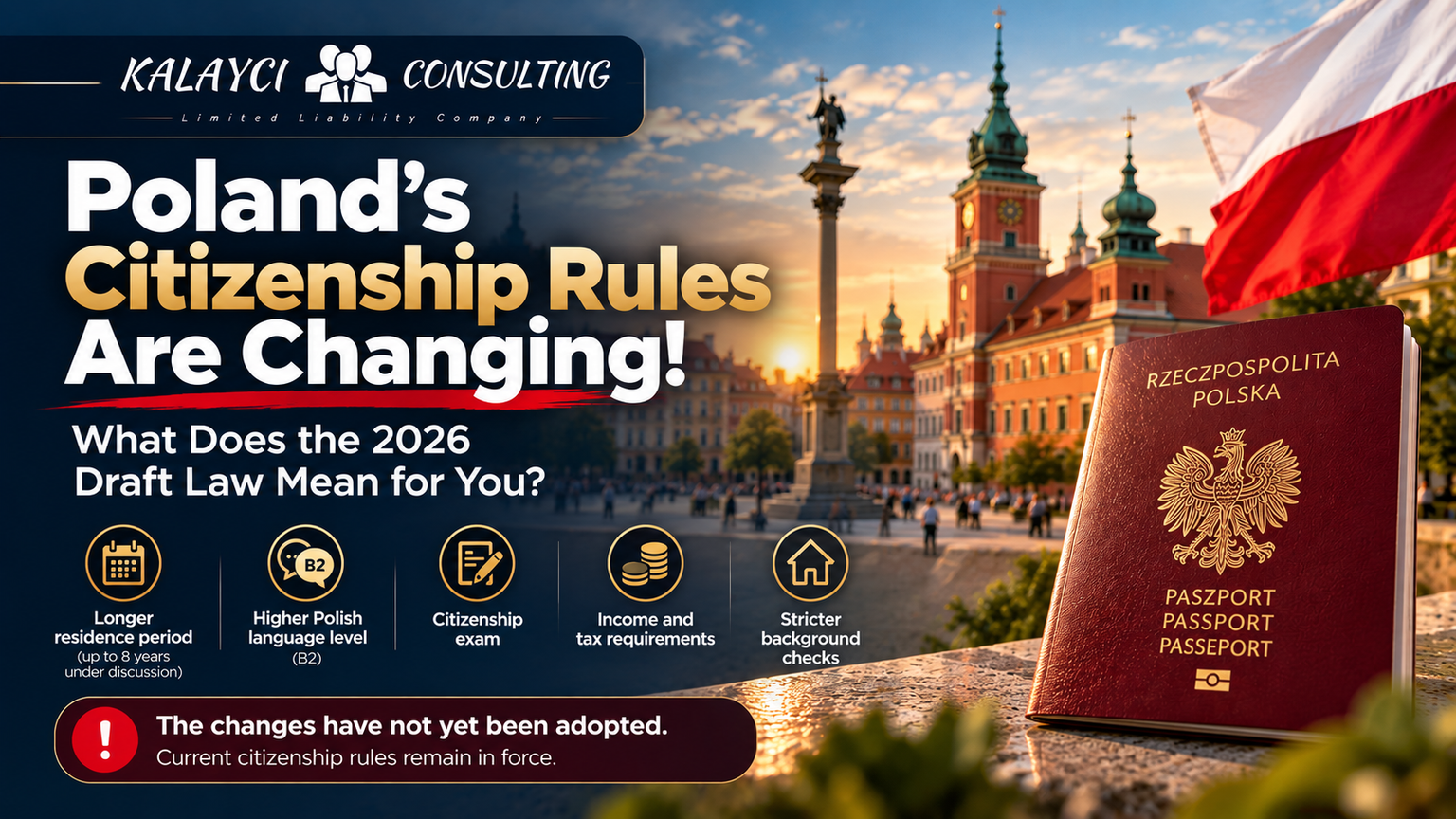
An important development has taken place that is of particular interest to foreign nationals who have been living in Poland for many years and are planning to apply for Polish citizenship.
On 27 October 2026, the Polish government placed a new draft bill on the official legislative agenda, aimed at significantly amending the conditions for citizenship.
The regulation, registered under number UD491, provides for an extension of the required period of residence for citizenship, an increase in the Polish language proficiency level from B1 to B2, the introduction of a citizenship test, and a more detailed examination of applicants’ income, tax and residence status.
So, what does this development mean for Turkish citizens living in Poland? Will it really become more difficult to obtain citizenship? How will current residence permit holders and those preparing to apply for citizenship be affected?
Here is what you need to know about the new regulations.
Important note: As of 28 October 2026, these changes have not yet come into force. UD491 is a draft bill included in the government’s legislative programme. The current Polish citizenship rules remain in force.
1. The Residency Period for Polish Citizenship May Be Extended
One of the most significant changes in the draft bill is the extension of the statutory residence period required for an application for Polish citizenship.
Under current legislation, there are different categories of application for recognition as a Polish citizen (uznanie za obywatela polskiego) by the voivodeship authority.
For example:
- 3 years: Individuals who have lived in Poland for three consecutive years on the basis of permanent residence (pobyt stały), an EU long-term residence permit (rezydent długoterminowy UE) or a right to permanent residence, and who meet the other conditions.
- 2 years: Special categories, such as individuals who meet specific residence conditions and have been married to a Polish citizen for at least three years.
- 1 year: Individuals who have obtained permanent residence on the grounds of Polish origin or the Karta Polaka.
- 10 years: A separate application route for individuals who have lived in Poland legally and continuously for at least ten years and who, at the time of application, hold the required permanent status and meet the other conditions.
Consequently, under the current system, the three-year period is not a general waiting period calculated from everyone’s first entry into Poland. The type of residence permit and the date from which it is valid are important.
Is an 8-year requirement being introduced in the new regulations?
According to statements published in the Polish press in October 2025, work was reportedly underway on a total residence period of eight years for the standard path to citizenship. The reports mentioned a three-year temporary and a five-year permanent residence period.
However, the official UD491 statement dated 27 October 2026 does not specify a precise number of years. It merely states that the mandatory residence period will be extended.
Therefore, it is not correct at this stage to state that the citizenship period has been definitively extended to eight years. The final duration will become clear once the text of the law is published.
2. Polish Language Requirement to Be Raised from B1 to B2
Another change that could directly affect those applying for citizenship relates to Polish language proficiency.
Currently, as a general rule in the citizenship recognition procedure, a minimum B1 level of Polish language proficiency is required, and this must be proven by means of accepted official documents.
The new draft, however, proposes raising this level to B2.
Whilst the B1 level indicates the ability to communicate at a basic level in everyday life and in a work environment, the B2 level requires the understanding of more complex topics, the detailed expression of thoughts and more independent use of the language.
If this change is adopted, candidates who currently have a B1 level of Polish but do not hold a B2 certificate may need to undertake additional preparation.
However, details regarding the status of current certificate holders and how alternative language proficiency certificates will be assessed have not yet been finalised.
3. The Polish Citizenship Test is Coming
Another innovation envisaged in the draft is the introduction of an exam for citizenship applicants to assess their knowledge of Poland.
Known as the ‘test obywatelski’, this exam is intended to assess the extent to which applicants have integrated into the country.
The exam is expected to cover areas such as Polish history, culture, social life and the basic legal system.
Previous press reports had mentioned an exam comprising approximately 40 questions and two exam sessions per year.
However, the official statement from UD491 does not specify the exact number of questions, the pass mark, the fee or the implementation schedule.
Consequently, whilst there are plans to make the exam compulsory, it is not yet clear how it will be implemented.
4. Declaration of Allegiance to Poland May Become Compulsory
The new draft bill also provides for foreign nationals applying for citizenship to formally declare their loyalty to the Republic of Poland.
This declaration, referred to in Polish as ‘deklaracja wierności wobec Rzeczypospolitej Polskiej’, aims to make the element of loyalty to the country a more prominent feature of the citizenship process.
According to the government’s approach, citizenship should not merely be the result of having resided in the country for a certain period; it should also serve as an indication of genuine ties with Polish society and compliance with social norms.
The full text of the declaration and the procedures for its implementation have not yet been announced.
5. Income, Taxation and the Centre of Life in Poland to Be Scrutinised More Closely
The draft bill is not limited to residence duration and language requirements alone.
There are also plans to assess the economic and social ties of those applying for Polish citizenship in greater detail.
The proposed regulations include:
- Having a certain minimum income level in Poland,
- The applicant’s centre of life must be in Poland,
- An assessment of the requirement for tax residency in Poland,
- Documentation of sources of income,
- Demonstration of a legal right of use over a property.
There is an important detail here: the requirements for regular income and proof of residence already apply to certain categories of citizenship under the current system.
The new draft aims to extend these obligations to all applicant groups seeking citizenship.
No definitive minimum income threshold has yet been announced. The documents required to prove tax residency and the periods covered will be clarified in subsequent regulations.
6. Fines and Criminal Records May Become More Significant
The new draft law also provides for an expansion of the circumstances that could lead to the rejection of a citizenship application.
According to the official statement, the following issues are to be assessed in greater detail:
- Finalised conviction orders,
- Fines imposed during a specific period prior to the application,
- Administrative penalties and sanctions,
- Provision of false or misleading information,
- The use of forged documents.
The explicit mention of fines in particular is noteworthy.
However, this does not mean that every traffic offence will automatically result in the rejection of a citizenship application.
It has not yet been determined which types of penalties, of what severity and within what timeframe, will be taken into account.
Therefore, at this stage, there is insufficient legal basis to state that an individual application will be rejected solely on the grounds of a financial penalty received in the past.
7. The Retrospective Revocation of Citizenship Decisions is Also on the Agenda
One of the most notable aspects of the draft bill concerns provisions relating to citizenship decisions alleged to have been obtained unlawfully.
The Government proposes that decisions recognising citizenship granted as a result of forged documents, false statements or the concealment of material information, and decisions to restore former citizenship, may be revoked without any time limit.
Furthermore, the investigation may not be limited solely to the documents submitted with the citizenship application. Previous residence permits and ‘Karta Polaka’ procedures may also be assessed within this scope.
However, there is an important legal distinction.
Article 34 of the Polish Constitution stipulates that citizenship cannot be lost against a person’s will. Consequently, the relationship between the proposed mechanism for revoking decisions and constitutional provisions, as well as its legal limits in practice, must be assessed separately.
Consequently, this provision of the draft bill is not yet in force and does not imply that citizenship can be automatically revoked on account of every past error.
8. How Will Holders of the Karta Polaka Be Affected?
There is also discussion regarding the extension of the naturalisation period for individuals who can prove their Polish origin and hold a Karta Polaka.
Under the current system, individuals who have obtained a permanent residence permit on the basis of the Karta Polaka and who meet the other legal requirements may apply for citizenship after one year of uninterrupted residence on the basis of this permit.
The Polish press has reported that extending this period to three years is under consideration.
However, as the official UD491 summary does not specify a definitive new period for holders of the Karta Polaka, this information should not yet be regarded as a finalised regulation.
9. The 2030 Deadline for the Restoration of Former Polish Citizenship
The draft bill also affects a special procedure applicable to individuals who were previously Polish citizens but have lost their citizenship.
It is proposed that the deadline for applications under the ‘przywrócenie obywatelstwa polskiego’ (restoration of Polish citizenship) procedure, as set out in Article 38 of the Polish Citizenship Act, be set at 31 December 2030.
This procedure is intended for individuals who previously held Polish citizenship but lost it under the historical conditions specified in the Act.
31 December 2030 is not the final deadline for all foreign nationals to apply for Polish citizenship. It relates solely to this specific procedure for the restoration of citizenship.
10. When will the new Citizenship Act come into force?
As of 28 October 2026, the date on which the new legislation will come into force has not yet been determined.
Draft UD491, prepared by the Polish Ministry of the Interior and Administration (MSWiA), is scheduled to be adopted by the Council of Ministers in the final quarter of 2026.
However, this stage does not mean that the law has come into force.
For the legislation to become law, it must pass through the relevant legislative processes, be signed by the President and be officially published.
Furthermore, the following questions remain unanswered:
- When will the new regulation come into force?
- What rules will apply to applications made prior to the legislative amendment?
- Will there be a transition period for holders of a B1 certificate?
- How will the new residence periods affect current permanent residents?
The answers to these questions will become clear once the detailed provisions of the draft legislation and the transitional provisions are published.
11. What Should Turkish Citizens Living in Poland Do Now?
For Turkish citizens planning to apply for citizenship in Poland, the most important issue is to correctly assess their current rights and the application requirements.
The following steps may be helpful during this process:
1. Check your residence status. Temporary residence, permanent residence and the EU long-term residence permit do not all meet the same citizenship requirements. Determine from which date your period of residence is calculated.
2. Check whether you meet the current eligibility criteria for citizenship. Those who already meet the criteria may consider applying in accordance with the legislation currently in force. However, it should be borne in mind that applying early does not guarantee that the old rules will apply.
3. Improve your language proficiency. Whilst a B1 level may be sufficient today, preparing for a B2 level could give you an advantage in the event of any future regulatory changes.
4. Organise your income and residence documents. It is important that employment contracts, income statements, tax records and documents relating to residential use are up to date and consistent.
5. Keep track of official developments. Not every statement circulating on social media constitutes a law that has come into force. Legal decisions must be based on current official regulations.
Conclusion: Will it become more difficult to obtain Polish citizenship?
The UD491 bill, announced by the Polish government on 27 October 2026, can be regarded as one of the most notable reform initiatives in the citizenship system in recent years.
The extension of the residence period, the B2 Polish language requirement, the citizenship test, the declaration of allegiance and more comprehensive financial checks all point to a stricter application process than the current system.
However, rather than saying that obtaining Polish citizenship has become more difficult at this stage, it would be more accurate to say that plans are in place to tighten the conditions for Polish citizenship.
The final requirements and the date of entry into force have not yet been finalised.
It would be advisable for those living in Poland who are considering applying for citizenship in the future to assess their residence status and the necessary documents now.
We will continue to update this article as further developments regarding the new draft legislation are announced.