
Permanent Residence or Long-Term EU Residence? What is the Difference Between Them, and Which is More Advantageous?
The two statuses most frequently confused by foreign nationals who have been living in Poland for several years are as follows: Zezwolenie na pobyt stały — Permanent Residence Permit and Zezwolenie na pobyt rezydenta długoterminowego UE — Long-Term EU Resident Residence Permit (EULT). In both cases, the residence permit is indefinite.

The two statuses most frequently confused by foreign nationals who have been living in Poland for several years are as follows:
Zezwolenie na pobyt stały — Permanent Residence Permit
and
EU Long-Term Resident Residence Permit (EULT)
In both cases, the residence permit is indefinite. Both allow the holder to live in Poland permanently and provide extensive access to the Polish labour market. However, the application requirements, who is eligible to apply, how previous periods of residence are calculated, and their status at EU level are not the same.
Therefore, the question is simply:
“Which is better?”
but, first and foremost:
“Which status’s requirements do I meet?”
.
The Most Important Difference: The Two Are Not the Same Type of Residence Status
Pobyt stały is a permanent residence status based on Polish national law. Its basic conditions are regulated under Article 195 of the Act on Foreigners. It is granted to foreign nationals falling within specific legal categories.
‘Long-term EU resident’ (Rezydent długoterminowy UE), on the other hand, is a separate status also regulated under EU law. Under Polish law, the basic substantive conditions are set out in Article 211, and, as a rule, a history of at least five years’ legal and uninterrupted residence in Poland is required.
Therefore:
“I have lived in Poland for five years, so I can now apply for a permanent residence permit.”
is generally incorrect.
However, for a person who meets the conditions:
“My five years’ residence are complete; am I eligible for a permanent residence permit?”
is the correct question to ask.
Who is Permanent Residence for?
Permanent residence is not a status that everyone can automatically attain after living in Poland for a certain number of years.
You must meet one of the specific legal grounds set out in the law.
These include, for example, where the conditions are met:
- a marriage to a Polish citizen,
- Polish origin (polskie pochodzenie),
- the Karta Polaka,
- a child of a Polish citizen who meets certain conditions,
- a child of a foreign national holding a permanent residence permit or an EULT who meets certain conditions,
- international protection and other special circumstances specified by law
may apply.
Therefore, simply stating:
“I have been working in Poland for 6 years.”
does not, on its own, constitute a legal basis for a permanent residence permit.
If this person meets the criteria, the route that should generally be considered is that of an ‘EULT resident’ in most cases.
Who is the EU Long-Term Resident status for?
The rationale behind the status of ‘long-term EU resident’ is different.
Here, rather than a specific family link or Polish origins, the foreign national’s long-term and stable residence in Poland is of primary importance.
As a general rule, immediately prior to the application:
at least five years’ lawful and uninterrupted residence
is required.
In addition, the applicant must also:
- a stable and regular income at the required level,
- health insurance,
- and proof of Polish language proficiency
.
For this reason, the EULT is one of the main routes to permanent residence for many foreign nationals who, for example, have been working in Poland for many years but have no Polish heritage, no Karta Polaka or any special family ties that would entitle them to permanent residence.
Is Completing 5 Years on Its Own Sufficient for EULT?
No.
One of the most common mistakes:
“I arrived in Poland five years ago, so I am entitled to EULT.”
This is a common misconception.
Not all periods of residence are counted equally when calculating EULT eligibility.
The MOS clearly states that some periods of residence are not counted at all, whilst others are counted only to a certain extent. For example, half of the duration of residence based on certain higher education, doctoral studies or vocational training may be included in the calculation.
Example
A person:
3 years as a university student + 2 years of work-based residence
, totalling 5 years’ residence in Poland.
If the period of study falls into the category counted at 50 per cent:
3 years × 50 per cent = 1.5 years
2 years’ work = 2 years
Total EULT calculation:
3.5 years
.
In other words, having been physically present in Poland for 5 years does not necessarily mean that the 5-year requirement for EULT has been met.
Why is the duration of study important?
This distinction is particularly important for foreign nationals coming to Poland for university education.
For example:
2 years as a student + 4 years working
in this case, assuming that the entire period of study counts as 50 per cent:
1 year + 4 years = 5 years
is obtained.
However, not all education- or ‘nauka’-based residence is the same. When applying, it is necessary to check separately on what legal basis the person is residing in Poland. The MOS also specifically emphasises that the calculation is unusual and that the basis of residence is important.
Can I Submit an EULT Application Before the 5 Years Are Up?
This is also an important distinction.
The residence period required for the EULT:
must have been completed immediately prior to the date of application.
Therefore:
“My five years will be up in two months’ time, and the process takes a long time anyway; I’ll apply now.”
is not the correct approach.
The period required by law must be met by the date of application.
Do You Always Have to Wait 5 Years for Permanent Residence?
No.
This is one of the key differences between Pobyt Stały and EULT.
The MOS explicitly states that a specific period of prior residence in Poland is not required in all cases for permanent residence.
This is because the conditions stem from the legal basis of the application.
For example, a person who holds a valid Karta Polaka and wishes to settle permanently in Poland is not required to have lived in Poland for five years simply to obtain permanent residence. The Ministry of the Interior (MOS) also makes this clear in its own Q&A section.
Conversely, a specific period of residence may be required for other categories of ‘pobyt stały’.
Therefore, for a ‘pobyt stały’:
“How many years have you been in Poland?”
the following question must be asked first:
“On what legal grounds are you applying for a pobyt stały?”
must be answered.
What if I am married to a Polish citizen?
There is a special procedure for permanent residence for foreign nationals married to a Polish citizen.
However, simply holding a marriage certificate is not sufficient.
In this specific route to permanent residence, legal conditions such as the duration of the marriage and the applicant’s uninterrupted period of residence based on the temporary residence permit granted due to the marriage are assessed together.
Therefore:
“I’ve married a Polish citizen, so I can now obtain permanent residence.”
There is no automatic rule to this effect.
It is also possible that the same person may need to meet the EULT conditions separately, depending on their past residence history.
In this case, two different legal pathways may arise, and the application must be assessed based on the person’s actual residence history. The substantive conditions for permanent residence are regulated under Article 195.
Is the residence permit indefinite for both?
Yes.
There is a very significant misunderstanding regarding this matter.
The ‘Pobyt stały’ permit is indefinite.
The EULT permit is also indefinite.
However, the validity period of the plastic residence permit card is different.
Permanent residence
Residence permit: indefinite
Residence card: 10 years
Long-term EU resident
Residence permit: indefinite
Residence card: 5 years
The expiry of the card does not mean that the residence permit automatically ceases. The card is renewed; provided the conditions for the status continue to be met, there is no need to reapply for an EULT or permanent residence permit each time.
Therefore:
“EULT is only a 5-year residence permit.”
is incorrect.
Five years is the validity period of the card, not of the status.
Is There a Difference in Terms of the Right to Work?
Both statuses provide a much stronger position in terms of working in Poland compared to temporary work-based residence permits.
A foreign national holding a Pobyt stały has full access to the Polish labour market. The Ministry of Labour explicitly states this.
In such permanent statuses, the structure differs from the classic ‘pobyt czasowy i praca’ model, where a person’s residence is tied to a specific employer.
This represents a significant practical advantage when it comes to changing employers.
So, what is the biggest difference from an EU perspective?
One of the most significant structural differences between the two statuses emerges here.
‘Pobyt stały’ is a status based on Polish national law.
The ‘long-term EU resident’ status, on the other hand, is a long-term resident status regulated under EU law.
The EU Long-Term Residents Directive provides for a system whereby a person granted this status may, under certain conditions, reside for more than three months in another Member State other than the one that granted the status.
This includes, for example, in another Member State:
- work,
- self-employment,
- education
.
However, there is a very important point to note here:
An EULT does not mean you can move to any country of your choice in the same way as an EU citizen.
An EULT holder does not automatically become an EU citizen and does not acquire the unrestricted right to free movement enjoyed by EU citizens.
Anyone wishing to move to another EU country on a long-term basis must also fulfil the procedures and conditions set out by the destination country for EULT holders. The Directive also makes long-term residence in a second Member State subject to certain conditions.
“Can I Move to Germany with a Pobyt Stały?”
Simply holding a Polish ‘pobyt stały’ card:
does not automatically confer an unlimited right to live and work in Germany.
With a Pobyt Stały and a valid travel document, short-term travel within the Schengen Area is possible; the MOS states that, provided the necessary entry and stay conditions are met, a stay of up to 90 days within a 180-day period is permitted in other Schengen countries.
However, a tourist or short-term Schengen trip is not the same as settling in another EU country.
“Can I go directly to Germany and work with an EULT?”
Here, too, it is important to pay attention to the word ‘direct’.
An EULT obtained in Poland grants access to the residence scheme in a second Member State, as provided for under EU law.
However:
“I’ll show my Polish EULT card and start working in Germany indefinitely without having to go through any procedures.”
This should not be interpreted in this way.
The second country’s own procedures apply. Whilst Article 14 of the Directive permits residence in another Member State for longer than three months, it also makes this subject to certain conditions.
This is one of the most significant practical differences between ‘pobyt stały’ and the EULT.
Is There a Big Difference Between the Two in Terms of Travel?
As far as short-term Schengen travel is concerned, the difference is not as great as people sometimes think.
Holders of a ‘pobyt stały’ may also undertake short-term travel within the framework of Schengen rules, provided they have a valid passport and residence card.
The main difference with the EULT is:
the possibility of long-term residence in another EU Member State
.
Therefore:
“I can travel to Europe with an ELUT but not with a permanent residence permit.”
is not correct.
Which of the following requires a B1 level of Polish?
Knowledge of the Polish language is an important material requirement for an EULT application.
The MOS explicitly lists documented knowledge of Polish amongst the necessary requirements.
As the permanent residence permit is based on entirely different legal grounds:
there is no general B1 requirement for all applications for permanent residence.
For example, applications for permanent residence made under the Karta Polaka scheme or on the basis of specific family ties should not be confused with the general language requirement under the EULT.
This distinction is particularly relevant when considering:
“Is a B1 certificate required for permanent residence?”
This distinction is particularly important:
The answer depends on the status applied for and the legal basis.
Which Requires an Income Threshold?
In the EULT, a stable and regular income is one of the basic requirements.
Moreover, it is not sufficient to have a salary on the day of application alone. The MOS stipulates that income must be assessed over the relevant period prior to the application, and this period may vary depending on the individual’s circumstances. The current MOS guide also sets out the income thresholds used for assessment from 1 January 2025 onwards.
Permanent residence, on the other hand, is a category-based system.
Therefore, regarding the income mechanism under the EULT:
“It is mandatory to demonstrate income in the same way for all applications for permanent residence.”
is incorrect.
What about health insurance?
Health insurance is also one of the explicitly required conditions for EULT.
A permanent residence permit, however, is a different system in which the legal basis of the application is examined.
Therefore, assuming that the lists of documents for the two procedures are the same could be a serious mistake.
Which Card Is Valid for a Longer Period?
In this regard, the physical validity period of the permanent residence card is longer:
Permanent residence card → 10 years
EULT card → 5 years
However, let us reiterate:
This refers solely to the validity period of the plastic card.
Both residence permits are valid indefinitely.
What happens if I stay outside Poland for a long time?
The term ‘indefinite residence’ does not mean that the status cannot be lost under any circumstances.
For example, the MOS states that staying outside Poland for more than six years is one of the grounds for the revocation of a ‘pobyt stały’ permit.
Under EULT status, there are also specific provisions in EU law regarding the loss of status, such as prolonged absence or acquiring long-term resident status in another Member State.
Therefore, after obtaining permanent residence:
“Even if I never return to Poland, my status will definitely continue for life.”
is incorrect.
Example 1: A Turkish National Who Has Been Working in Poland for 6 Years
Mehmet arrived in Poland in 2020.
He has been living and working here legally for six years.
He does not have a Polish spouse.
He has no Polish origins.
He does not hold a Karta Polaka.
He simply says:
“I have been in Poland for six years,”
cannot apply for permanent residence on this basis alone.
However, if their periods of residence comply with the EULT calculation, are continuous, and meet the requirements regarding income, insurance and proficiency in Polish, the EU long-term resident procedure should be considered.
Example 2: A University Graduate Who Has Been in Poland for 5 Years
Ayşe:
- She studied at university for 3 years,
- and has been working for the past 2 years.
Total physical residence:
5 years.
However, if half of her time as a student is counted under the relevant rules, the EULT calculation is:
1.5 + 2 = 3.5 years
.
Therefore, based solely on the date of the first entry into Poland as recorded in the passport:
“The 5 years have been completed.”
is not correct.
Example 3: Karta Polaka Holder
Ali holds a valid Karta Polaka and wishes to settle permanently in Poland.
From Ali’s perspective:
“I must first live in Poland for five years.”
There is no such general requirement.
The MOS clearly states that a holder of a valid Karta Polaka is not required to prove their previous period of residence in Poland for the purpose of obtaining pobyt stały.
In this case, rather than accumulating five years for EULT, the existing legal basis for permanent residence (pobyt stały) must be assessed separately.
Example 4: A Person Meeting the Conditions for Both Statuses
For some individuals, different legal options for both ‘pobyt stały’ and EULT may arise over time.
In such cases, rather than simply looking at the names of the cards, the following questions should be considered:
- Which of these do I currently meet the application criteria for?
- How do my past periods of residence count towards my EULT?
- Is my income history sufficient?
- Do I have a Polish-language document?
- Do I have plans to move to another EU country in the future?
- In terms of applying for Polish citizenship, which legal status and residence history are relevant in my case?
Because the right choice may vary depending on a person’s background and future plans.
So, which is more advantageous?
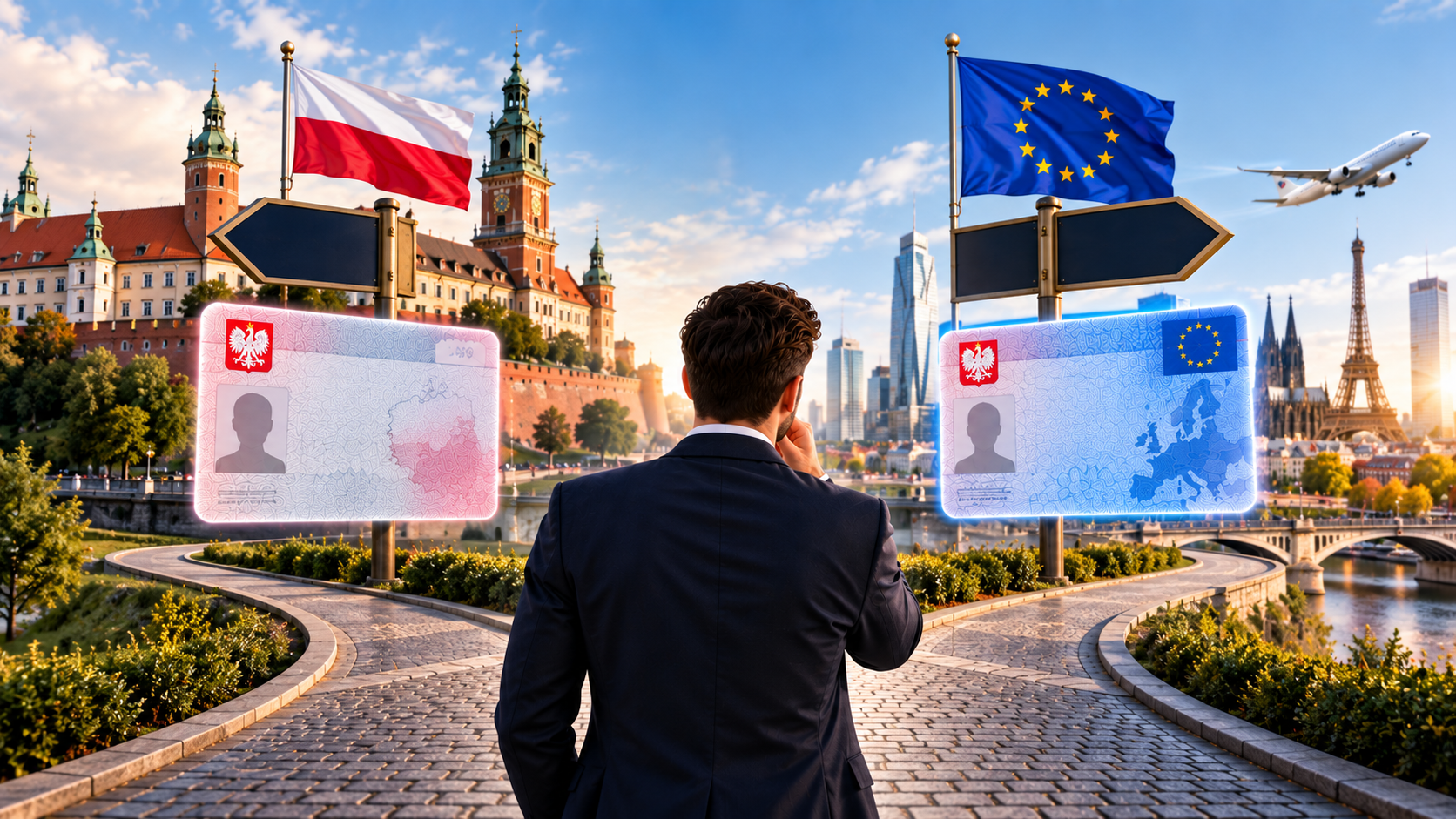
Rather than assessing this in terms of a single ‘winner’, you need to consider which feature is important to you.
For someone who may work, study or reside in another EU country for more than three months in the future, the EULT’s ‘second Member State’ mechanism, derived from EU law, represents a significant distinction. However, this mechanism does not constitute automatic EU free movement.
Conversely, a person with a specific legal basis for a ‘pobyt stały’ (permanent residence permit) may be subject to a different procedure from the EULT’s general five-year residence, income and language requirements. Furthermore, the physical validity of a ‘pobyt stały’ card is 10 years, whilst that of an EULT card is five years.
Therefore, the most appropriate question is:
“Which is generally better?” but rather “Which status’s conditions and consequences are more suitable for me, given my current legal situation and future plans?”
.
Common Mistakes
We can summarise the most common misconceptions regarding these two statuses as follows:
- Assuming that you will automatically be granted ‘pobyt stały’ after living in Poland for 5 years
- Mistaking the EULT for a ‘pobyt stały’
- Counting the entire duration of your student years towards the 5-year EULT requirement
- Submitting an EULT application before the required 5 years have been completed
- Interpreting the fact that the EULT card is valid for 5 years to mean that the residence permit is also valid for 5 years
- Assuming that an EULT holder can automatically live in any country just like an EU citizen
- Believing that one cannot travel to Schengen countries with ‘pobyt stały’
- Assuming that the general B1 requirement applies to every ‘pobyt stały’ application
- Calculating the EULT validity period based solely on the date of first entry into Poland.
Conclusion
‘Pobyt stały’ and ‘long-term EU resident’ are two distinct types of indefinite residence status.
Permanent residence is based primarily on specific personal or family legal circumstances set out in the law and is a national Polish status.
EULT, on the other hand, is a status governed by EU law, generally based on at least five years of appropriate, lawful and uninterrupted residence, sufficient income, health insurance and documented knowledge of the Polish language.
It is particularly important for foreign nationals who have been living in Poland for years as students or workers to examine the legal basis for each day counted and each period of residence individually before submitting an application.
This is because physically being present in Poland for 5 years is not always the same as having completed 5 years for the purposes of EULT.
This article has been prepared for general information purposes. Eligibility for application must be assessed on a case-by-case basis, taking into account the individual’s nationality, residence history, types of residence permits, trips abroad, family circumstances and other personal circumstances.
Legal Basis and Official Sources
- Ustawa o cudzoziemcach – Daimi Oturum İzni (Zezwolenie na pobyt stały) — Elektroniczny Dziennik Ustaw (ELI)
- Uzun Dönem AB Mukimi Oturum İzni – Zezwolenie na pobyt rezydenta długoterminowego UE — Urząd do Spraw Cudzoziemców – Moduł Obsługi Spraw (MOS)
- 2003/109/EC Sayılı AB Direktifi – Uzun Dönem Mukim Üçüncü Ülke Vatandaşlarının Statüsü — EUR-Lex – European Union
- Ustawa o cudzoziemcach – Uzun Dönem AB Mukimi Oturum İzni — Elektroniczny Dziennik Ustaw (ELI)