
When Does the 5-Year Period in Poland Come to an End? How Are Residence and Citizenship Periods Calculated?
“It has been five years since my first entry into Poland. Can I now apply for permanent residence or citizenship?” The answer to this question cannot always be determined simply by counting the years.
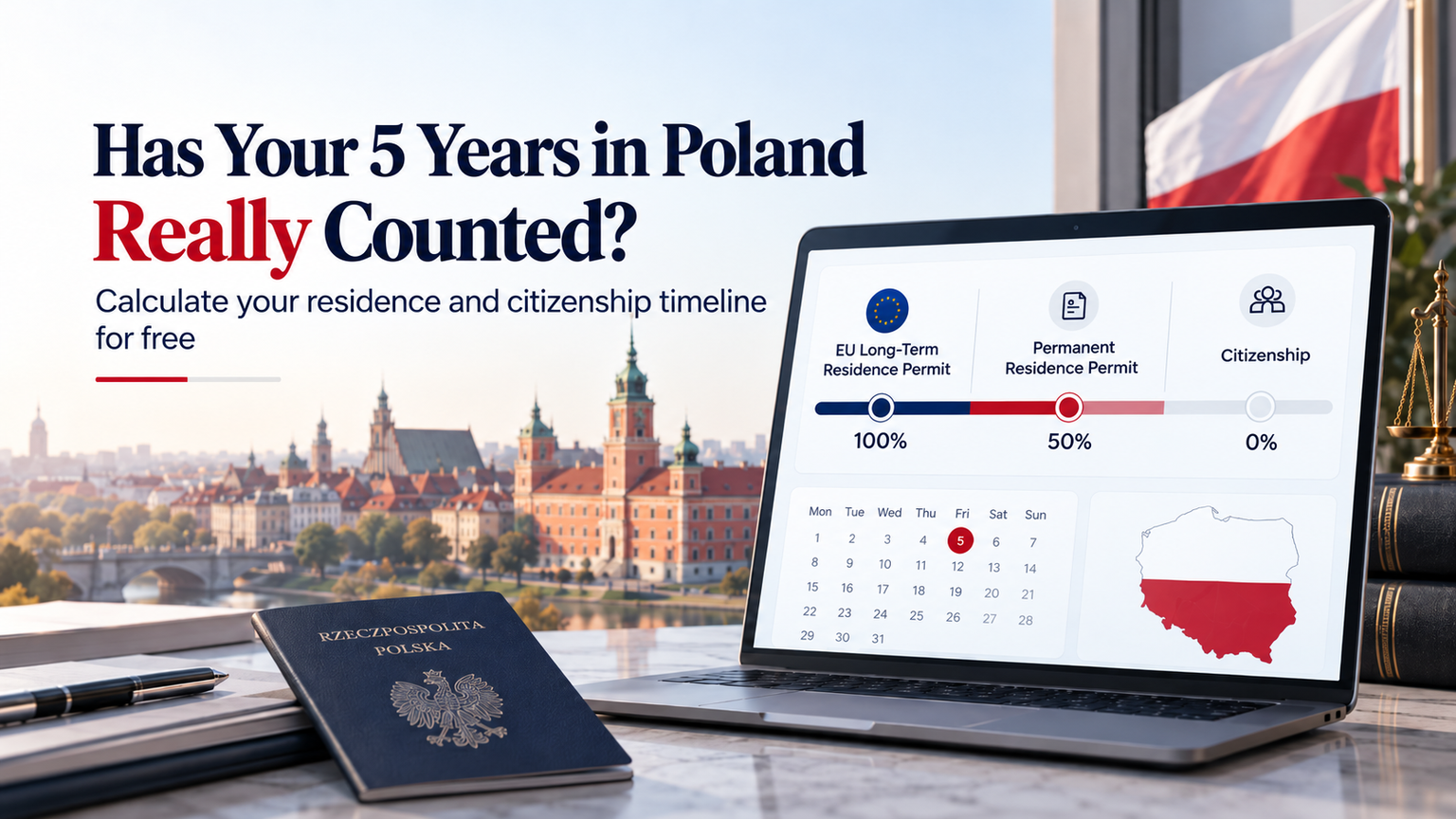
“It’s been five years since I first entered Poland. Can I now apply for permanent residence or citizenship?”
The answer to this question cannot always be determined simply by counting the years.
This is because, under Polish immigration law:
- The date of first entry into Poland,
- the period spent on a visa,
- the period spent as a student,
- residence for work purposes,
- the time elapsed until the residence application is finalised,
- time spent abroad,
- the period during which one holds permanent residence or an EULT
are not assessed in the same way.
For this reason, calculating the period from the first entry stamp in the passport to the present day often does not yield the correct result.
Furthermore, EU long-term residence (rezydent długoterminowy UE), permanent residence and Polish citizenship are entirely different procedures.
In this article, we will explain these differences as simply as possible.
1. “I have lived in Poland for 5 years” is not sufficient on its own
First of all, let’s clear up the most important misconception.
Having been in Poland for 5 years does not automatically mean that:
entitle you to permanent residence.
The five-year period is particularly important in the context of the ‘Rezydent długoterminowy UE’, i.e. the EU long-term residence permit.
The basic rule for this permit is that you must have resided legally and continuously in Poland for at least five years immediately prior to the date of application. In addition, there are other requirements, such as a regular and stable income, health insurance and the necessary knowledge of Polish.
However, when calculating these five years, not all periods carry the same weight.
How is the time spent as a student calculated?
The most common area where mistakes are made is the period spent as a student.
In Poland, ‘studia’ – that is, specific visa and temporary residence periods spent for the purpose of higher education – are, as a rule, counted at a rate of 50 per cent towards the EULT calculation. Article 212 of the Aliens Act also stipulates that half of the ‘studia’ and certain periods of vocational training are to be taken into account.
For example:
2 years of ‘studia’ + 4 years of fully recognised employment
the simple calculation might be as follows:
2 years of study × 50 per cent = 1 year
and
4 years’ employment = 4 years
Total:
5 years
However, the continuity of residence and the valid legal basis for each period must also be met.
‘Studia’ and ‘nauka’ are not the same thing
These two concepts are often confused.
In everyday Turkish, both may be referred to as ‘student status’, but from the perspective of immigration law, their legal categories may not be the same.
Whilst certain periods of higher education classified as ‘studia’ may count towards the EULT calculation at a rate of 50 per cent, periods excluded under the ‘nauka’ category in the law may not be included in the 5-year EULT calculation.
Therefore, simply stating:
“I was a student at that time.”
is not sufficient.
The purpose of the visa, the legal basis for the residence decision and the status applicable during the relevant period must be verified.
Is a work residence permit counted in full?
Normal periods of lawful residence spent for the purpose of work may, as a rule, be taken into account in full when calculating the EULT, provided they do not fall within one of the specific categories excluded by law.
However, even here, it may not be correct to rely solely on the name stated on the card.
In particular:
- if there are gaps between permits,
- if the application has entered the waiting period for a decision,
- if the application has been refused,
- if two different legal statuses have overlapped,
- or if there are periods during which the person has been outside Poland for a long time,
the account must be examined separately.
For this reason, in our calculation tool, for certain periods where the legal basis cannot be definitively established, we display the result ‘manual check required’ rather than providing specific dates.
How is the time spent whilst the residence application is pending calculated?
This is also one of the issues we frequently encounter.
For example, a person’s residence card is due to expire, a new residence application is submitted, and it can take 1–2 years for a decision to be made.
Is this period automatically counted as:
“It counts in full because I was in Poland.”
may not be correct.
The type of application, the person’s previous status, the final outcome of the application, and the legal basis on which the person was residing during that period are all important factors.
For this reason, periods spent awaiting a decision must be assessed with particular care.
Does travelling abroad reset the five-year period?
Not every trip abroad resets the 5-year period.
For example:
- A 10-day holiday in Turkey,
- a trip to Germany lasting a few days,
- a short family visit
are not, under normal circumstances, counted by deducting individual days from the period of residence.
The key issue here is the requirement for uninterrupted residence — the ‘nieprzerwany pobyt’ condition.
Under the general rule of the EULT, it is important that interruptions do not exceed six months at any one time, or a total of ten months within the relevant period. The law also provides for exceptions in certain specific circumstances.
Under the EU Blue Card scheme, there may also be specific mobility rules. In particular, special 12/18-month rules may apply to periods spent in another EU country under the Blue Card scheme; therefore, Blue Card cases should not be automatically assessed using the standard 6/10-month calculation.
So, is five years sufficient for permanent residence?
No.
This is very important.
A ‘zezwolenie na pobyt stały’, that is, a permanent residence permit in Poland, is not a permit that everyone automatically obtains after living in Poland for a certain period.
You must have a specific legal basis, as set out in the law, for permanent residence. These include, for example, if the conditions are met:
- the Polish Card,
- Polish ancestry,
- marriage to a Polish citizen,
- certain child or family circumstances,
- refugee status,
- subsidiary protection,
- humanitarian residence,
- certain other special circumstances
may be included.
Therefore:
“I have been living in Poland on a work permit for 8 years; I can now apply for permanent residence.”
is generally incorrect.
In such a situation, the main route that usually needs to be considered is that of an EU long-term resident.
If I am married to a Polish citizen, when can I apply for a permanent residence permit?
In the case of marriage to a Polish citizen, two separate periods are assessed together.
Generally, the person must:
have been married to a Polish citizen for at least three years
and, at the same time, immediately prior to the application:
have lived in Poland continuously for at least 2 years on the basis of a valid temporary residence permit linked to the marriage
.
Therefore:
“I have been married for 3 years.”
may not be sufficient on its own.
Similarly:
“I’ve been living in Poland for two years.”
is not sufficient either.
Both conditions must be met together.
How many years are required for citizenship?
There is no single answer here either.
In the procedure for recognition as a Polish citizen (uznanie za obywatela polskiego), the timeframes vary depending on the legal route the person takes.
For example, in one of the most common routes, the person:
- permanent residence,
- long-term EU resident,
- or the right of permanent residence
. This route also requires meeting conditions such as a regular income and legal entitlement to accommodation.
The key point here is:
The three-year period for citizenship does not generally start from your previous student or work residence permit.
For example:
- You lived in Poland for 7 years on a work permit,
- and then obtained an EULT.
Under the standard 3-year citizenship route, the previous 7 years are not automatically added to this 3-year period.
The relevant period is assessed on the basis of the required permanent status.
Citizenship through marriage to a Polish national
Here, too, there are two separate periods.
In some cases, a person:
- has been residing in Poland continuously for at least two years with the appropriate permanent status
- and has been married to a Polish citizen for at least 3 years
may consider applying for citizenship.
In other words, the duration of the marriage and the duration of residence status must be calculated separately.
“I’ve been in Poland for 10 years – can I apply for citizenship?”
Under Polish citizenship law, there is also a route based on 10 years of legal and uninterrupted residence.
However, again:
“I have spent 10 years in Poland.”
is not sufficient on its own.
At the time of application, the individual must hold one of the required permanent residence statuses and must also meet the other conditions of the relevant route.
Therefore, the total period of 10 years must be assessed in conjunction with the applicant’s current residence status.
The calculation of the period for citizenship via the Presidency is different
The granting of Polish citizenship by the President of the Republic of Poland differs from the ‘recognition’ procedure described above.
In this case:
“I can apply once three years have passed”
or
“I become eligible after 5 years”
.
This is a separate citizenship procedure subject to discretion.
For this reason, it would be incorrect to provide a false ‘earliest date for citizenship’ in automatic citizenship calculations for the Presidential route.
The biggest mistake: adding up all the periods in a single line
For example, let us assume a person’s history is as follows:
- 1 year of study,
- 2 years of study,
- 3 years’ work permit.
Total in calendar years:
6 years
may have elapsed.
However, the duration on this person’s EULT account is not automatically 6 years.
This is because during certain periods:
- 100 per cent,
- some at 50 per cent,
- and some at 0 per cent
.
Furthermore, gaps in overseas travel records or legal statuses may also affect the calculation.
Therefore:
“I first came to Poland in 2019, and my five years were completed in 2024.”
A simple calculation like this can lead to incorrect results in many cases.
How can you calculate the earliest possible application date?
Calculating these manually can be particularly difficult, especially for those with more than one type of residence status.
For this reason, at Kalaycı Consulting, we have developed a free Polish Residence and Citizenship Duration Calculator.
With this tool:
- you can enter your periods of residence separately,
- view the calculation of your study periods,
- check which periods are counted in full or not at all,
- see the impact of your trips abroad on your uninterrupted residence,
- calculate your estimated earliest date for EULT,
- check whether you have a valid legal basis for permanent residence,
- and compare the different legal routes to citizenship.
Furthermore, the tool does not simply provide a result.
“Why was this period counted as 50 per cent?”, “Why wasn’t this period included?”, “Why is a manual check required?”
You can also see the answers to questions such as these on the results screen.
The calculation is carried out in your browser; the residence and travel history you enter is not sent to our servers by default.
Calculate your time in Poland now
If you want to see how many years of your time in Poland are actually taken into account and what stage you are at in terms of EULT, permanent residence or citizenship, you can use our free calculation tool:
Open the Poland Residence and Citizenship Duration Calculator
Once you have received your result, if there are any unclear periods in your file or if the system displays a ‘manual check required’ warning, you can contact the Kalaycı Consulting team to have your situation assessed further based on your documents.
Legal Basis and Official Sources
- Ustawa z dnia 12 grudnia 2013 r. o cudzoziemcach – tekst jednolity, Dz.U. 2025 poz. 1079 — Sejm RP
- Ustawa z dnia 2 kwietnia 2009 r. o obywatelstwie polskim — Sejm RP
- Zezwolenie na pobyt rezydenta długoterminowego UE — Moduł Obsługi Spraw – Urząd do Spraw Cudzoziemców