
My Residence Application Has Been Rejected: Do I Have to Leave Poland Immediately? Can I Stay If I Appeal?
One of the situations that causes the most concern for foreign nationals applying for a residence permit in Poland is receiving a negative residence decision (decyzja odmowna) after a long wait. This is particularly true for those who submitted their application months or even years ago and whose previous visa or residence permit has expired in the meantime.
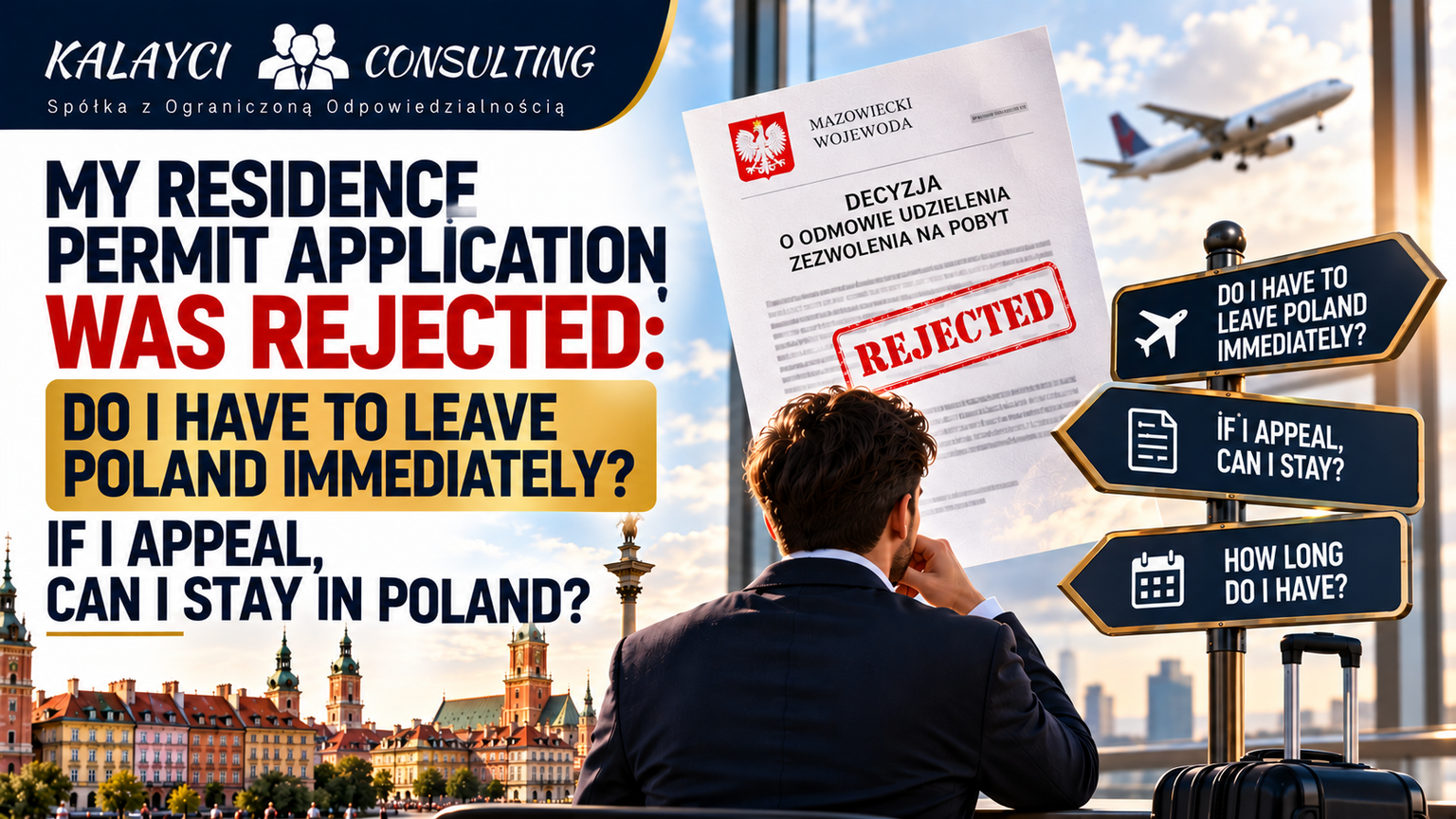
One of the situations that causes the most concern for foreign nationals applying for a residence permit in Poland is receiving a negative residence decision (decyzja odmowna) after a long wait.
A rejection can create significant uncertainty, particularly for those who submitted their application months or even years ago and whose previous visa or residence permit has expired in the meantime.
The questions we are most frequently asked are as follows:
My residence application has been refused. Do I have to leave Poland immediately?
If I appeal against the decision, can I remain in Poland legally?
When does the 14-day period for lodging an appeal begin?
Can I continue to work whilst appealing?
If my appeal is also rejected, how long do I have to leave the country?
Can I submit a new residence permit application instead of lodging an appeal?
The answers to these questions depend on the stage at which the rejection decision was made, when the decision was served, whether the application was made lawfully in the first place, and whether the person has any other legal right to remain.
Let us make the most important point clear from the outset:
A rejection of a residence application does not, in every case, mean you must leave Poland on the same day. However, missing the appeal deadline may result in you losing your legal right to remain.
1. What Happens When a Residence Application Is Rejected?
In Poland, if an application for a temporary residence permit (zezwolenie na pobyt czasowy), permanent residence permit (zezwolenie na pobyt stały) or long-term EU resident residence permit (zezwolenie na pobyt rezydenta długoterminowego UE), the competent authority issues a reasoned administrative decision.
The Polish term for this decision is generally ‘decyzja o odmowie udzielenia zezwolenia’.
The rejection decision normally contains the following information:
The legal grounds on which the application was refused,
Which documents and conditions the authority assessed,
The provisions of the law on which the decision is based,
The appeal procedure available against the decision,
The timeframe within which an appeal must be lodged and the authority to which it should be addressed.
The first thing to do after receiving a rejection decision is not merely to read the outcome on the final page of the decision, but to carefully examine the grounds for the decision (uzasadnienie) and the information on appealing (pouczenie).
This is because not every rejection decision is appealed in the same way.
For example, a change in educational status in a residence application made for study purposes, missing employer documents in a work-based residence application, or failure to complete the required period of residence in an EULT application all require different legal assessments.
2. I Have Received a Rejection Decision. Do I Have to Leave Poland Immediately?
No, you are not required to leave immediately following every rejection decision.
It is important to distinguish between two types of decision:
First-instance rejection decision: A decision issued by the Wojewoda, against which the standard appeal route is open.
Final administrative rejection decision: A decision for which the standard administrative appeal process has been completed or the appeal period has expired without being utilised.
This distinction is important. This is because there may be provisions allowing a foreign national, whose application has been made in accordance with the law, to remain in Poland lawfully whilst their residence proceedings are ongoing.
In particular, Article 108 of the (Ustawa o cudzoziemcach) provides that, provided an application for temporary residence is submitted within the statutory period of lawful stay and the necessary procedural requirements are met, the foreign national’s stay shall be deemed lawful until the decision becomes final in administrative terms.
Similar protection mechanisms may also apply in applications for permanent residence and EULT, within the framework of the relevant cross-referenced provisions.
However, this protection is not automatically granted in every application. In particular, the timing of the application and whether any procedural deficiencies have been rectified must be checked.
3. How Many Days Do I Have to Appeal Against a Rejection Decision?
The general time limit for appealing against rejection decisions issued by the Wojewoda regarding residence applications in Poland is:
14 days
from the date of proper service of the decision
The Polish term for an appeal is ‘odwołanie’.
In accordance with general administrative procedure rules, this period is calculated from the day following the date on which the decision was served.
Example
Suppose a decision rejecting an application was served on a foreign national on 5 October 2026.
Under normal calculation, the last day of the 14-day appeal period would be 19 October 2026.
However, if the final day of the period falls on a public holiday or a Saturday, the relevant administrative procedural rules apply to the calculation of the period.
Important: The date of issue stated on the decision may not be the same as the date on which it was served to you.
Therefore, the 14-day period must be calculated from the date of lawful service, not the date the decision was signed.
4. If I lodge an appeal, can I remain in Poland legally?
Yes, provided your application meets the necessary legal requirements and you lodge an appeal within the time limit, your stay in Poland may be considered lawful whilst the administrative appeal process is ongoing.
The following conditions are particularly important in this regard:
The initial residence application must have been submitted whilst you were legally resident in Poland.
The application must have been made in accordance with the prescribed procedure, or any formal deficiencies must have been rectified within the prescribed time limit.
A valid appeal must be lodged against the rejection decision within the statutory time limit.
In this case, the first-instance rejection decision does not, in itself, immediately terminate the protection of lawful residence during the residence application process.
The administrative appeal process may continue until a decision is issued by the Head of the Office for Foreigners.
However, there is a crucial distinction here:
Lodging an appeal does not mean that the person will be granted a new residence permit. It merely ensures that their stay in Poland is deemed lawful during the ongoing administrative procedure, subject to the conditions laid down by law.
If the initial application was already made whilst the person was staying unlawfully, simply submitting an appeal does not automatically rectify the past unlawful stay.
5. Where and How Should I Submit the Appeal?
Appeals against decisions refusing a residence permit are generally:
addressed to the Head of the Office for Foreigners.
However, they are not submitted directly to this authority, but via the Wojewoda who issued the decision.
For example, in the case of a refusal decision issued by the Mazowiecki Wojewoda in Warsaw, the appeal is forwarded to the higher authority via the Mazowiecki Wojewoda.
According to the official statement from the MOS, the appeal may be submitted in writing by post, via the relevant authority’s document reception desk, or via the appropriate electronic notification address. Although a form is available on the MOS portal to assist with preparing the appeal, simply completing the form on the MOS portal does not constitute an official submission.
What should the appeal letter contain?
The appeal must clearly state the individual’s personal and case details, the date and reference number of the decision being appealed, the specific aspects of the decision being contested, and the requested outcome.
For example, the authority may have issued a rejection decision on the grounds that the applicant does not have sufficient income. However, if there is a current employment contract, income documents or other evidence in the file that the authority has not taken into account, these may be considered during the appeal stage.
Rather than simply stating ‘I do not accept the decision; please reconsider it’, it is more helpful for the assessment of the case to counter the grounds for rejection with concrete evidence.
6. What Happens If My Appeal Is Upheld?
The decisions that the higher authority may make following an appeal vary.
Reversal of the rejection decision and granting of a residence permit
The higher authority may overturn the first-instance rejection decision, having established that the necessary conditions have been met, and grant a residence permit.
Referral of the case to the Wojewoda for re-examination
The decision may be set aside and the case referred back for re-examination, particularly in the event of significant procedural errors or inadequate examination.
Confirmation of the refusal decision
The higher authority may uphold the first-instance decision, deeming it in accordance with the law, and leave the rejection decision in force.
All three of these outcomes are set out in MOS’s official statements on appeals.
Case Handling Module+1
7. If my appeal is also rejected, within how many days must I leave Poland?
This is one of the most important sections of this article.
As a general rule, unless you have another legal basis for remaining in Poland, you must leave the country within 30 days of a final decision rejecting your application for residence.
For example, if the Head of the Office for Foreigners (Szef Urzędu do Spraw Cudzoziemców), as the higher authority, rejects your appeal, the relevant 30-day period is generally calculated from the date on which this decision is served upon you.
Similarly, if you do not lodge an appeal against a first-instance refusal decision, a 30-day departure period may apply from the date the decision becomes administratively final.
The individual’s circumstances are crucial for the application of this 30-day rule. In particular, if the application was made whilst staying in the country unlawfully or if a separate return decision is in place, different outcomes may arise.
MOS’s official guidelines clearly explain the 30-day obligation to leave for individuals with no other grounds for remaining in the country.
Example
Mehmet applied for a work-based residence permit.
He lodged an appeal against the initial refusal decision within the prescribed time limit. The higher authority upheld the refusal decision, and the decision was served on Mehmet on 10 November 2026.
Assuming that Mehmet has no other valid right of residence and that the general 30-day rule applies, 10 December 2026 will be the final day of the departure period.
It is important to bear in mind that this period does not constitute the validity period of a new residence card and does not confer the right to settle in another EU country.
8. Can I Continue to Work During the Appeal Process?
Being legally entitled to stay in Poland is not the same as being legally entitled to work.
This distinction is particularly important in the context of work-based residence applications.
Even if a person’s stay is deemed lawful under certain conditions whilst their residence application and appeal are ongoing, this does not automatically constitute a work permit.
In order to continue working, the individual must hold a separate right to work.
For example, depending on the specific circumstances, this right may be based on:
a valid work permit,
an exemption from the work permit requirement,
The continuation of the right to work prior to the application, in accordance with the legal conditions,
or a status conferring another valid right to work
.
This issue should be examined in particular for those who have changed employers, whose student status has ended, or whose previous work permit has expired.
The assumption that ‘I have lodged an appeal, so I can work for the employer of my choice’ is not legally sound.
9. Can I travel to Turkey whilst appealing? Can I return to Poland?
A common mistake in this regard is to assume that the right to remain legally in Poland is the same as the right to re-enter the country.
An ongoing residence application or appeal process does not, in itself, grant the right to re-enter Poland.
For example, your visa may have expired whilst your residence application is still pending. Even if your stay in Poland is deemed lawful due to your appeal, you must have a valid basis for entry in order to return once you have travelled to Turkey.
For Turkish nationals, this generally means a valid visa, a valid residence card or another applicable legal right of entry.
A document showing that the application is ongoing, a UPO or an application stamp in your passport does not, on its own, serve as a substitute for a Schengen visa.
For this reason, particularly those whose previous residence card has expired must check the conditions for re-entry before leaving the country.
10. My appeal has also been rejected. Can I take the matter to court?
Yes. Once the administrative appeal process has been completed, an application may be made to the administrative court under certain conditions.
This application is known as a ‘skarga do Wojewódzkiego Sądu Administracyjnego (WSA)’.
Generally, a case may be brought before the administrative court within 30 days of the notification of the higher authority’s decision. The application is, as a rule, submitted via the higher authority that issued the decision.
However, there is a very important distinction here:
Bringing a case before the administrative court does not mean that the application for residence is still pending at the administrative stage, nor does it, on its own, legalise one’s stay in Poland.
A person who has no other legal basis for their stay should not assume that they can remain in Poland indefinitely simply on the grounds that they have lodged an application with the court.
Furthermore, the higher authority’s confirmation of the rejection decision and its referral of the case back to the Wojewoda give rise to different legal consequences. The judicial remedy available and the time limit applicable in the latter case may also differ.
11. Can I Apply for Residence Again After a Rejection Decision?
The answer to this question depends on the individual’s current legal residence status.
In particular, one should not assume that the 30-day period granted to leave Poland following a final rejection decision automatically confers the right to submit a new application for residence.
MOS’s official statements clearly state that, if a new application for residence is made within this period, the initiation of proceedings may be refused (odmowa wszczęcia postępowania).
Therefore:
“My appeal has been rejected, but if I apply again within 30 days, I can continue to stay in Poland.”
This approach carries significant risks.
Before submitting a new application, it must be examined whether the individual has any other valid right of residence and whether the new application is legally admissible.
12. What Happens If I Miss the Appeal Deadline?
Once the 14-day appeal period has expired, the decision generally becomes final in administrative terms.
However, under certain conditions, a request for ‘przywrócenie terminu’ – that is, the reinstatement of the missed deadline – may be made.
This mechanism is not an automatic right available to everyone who has missed the deadline.
The individual must demonstrate that they missed the deadline through no fault of their own. Under the general provisions of administrative procedure, the request must be made within 7 days of the obstacle ceasing to exist, and the missed procedure must also be carried out.
For example, circumstances such as a serious hospitalisation or service of a notice in breach of procedure may be considered on a case-by-case basis.
However, solely on the grounds that:
“The decision was not visible in the INPOL system.”
does not, in every case, mean that the time limit for lodging an objection will be extended.
It must be investigated whether the decision was legally served by post, electronic notification or through an authorised representative.
13. Will I Be Deported If My Application Is Rejected?
The rejection of a residence application is not the same as a decision requiring a foreign national to leave the country (decyzja o zobowiązaniu cudzoziemca do powrotu).
A decision to refuse a residence permit is the refusal to grant the residence permit requested by the foreign national.
A return order, however, is a separate administrative procedure and may entail different legal consequences.
However, failing to leave Poland after a residence permit refusal decision has become final, despite having no other right to remain, may result in the return procedure being initiated.
For this reason, the 30-day departure period should not be regarded as a free waiting period from which no legal consequences will arise.
14. Three Examples of a Refusal Decision and the Appeal Process
Example 1: A person whose student residence permit has been refused
Ayşe applied for a student residence permit whilst legally residing in Poland. She fulfilled the procedural requirements for her application.
Some time later, she received a rejection decision due to a shortcoming in her university enrolment.
Ayşe lodged an appeal within the 14-day period, submitting her current student certificate and other relevant documents.
As her application met the conditions for legal residence protection, her stay in Poland is considered lawful throughout the appeal process.
However, this does not mean that the work exemption arising from student status automatically continues.
Example 2: A person whose work permit application was refused
Mehmet’s work-based residence permit application was refused due to issues with the employer’s documents.
Mehmet lodged an appeal against the rejection decision within the prescribed time limit.
Following a review by a higher authority, the initial decision was overturned and the case was referred back to the Wojewoda for reassessment.
In this case, the case may be subject to a further administrative review.
Mehmet’s right to stay and work in Poland, however, must be assessed separately in accordance with his application history and the legal requirements.
Example 3: A person whose appeal was also rejected
Ali received a rejection decision regarding his application for temporary residence and lodged an appeal.
The higher authority also upheld the rejection decision.
Ali has no other valid grounds for residence or stay.
In this situation, as a general rule, the obligation to leave Poland within 30 days from the date of notification of the higher authority’s decision applies.
The fact that Ali has applied to the court does not, in itself, resolve this issue of his right to remain.
15. What Should You Do If Your Application Has Been Rejected?
Checklist following a rejection decision
Examine the full decision, paying particular attention to the ‘uzasadnienie’ section. Determine the legally valid date of service. Calculate the final day of the 14-day appeal period. Check that the initial application was made whilst you were legally resident and in accordance with the correct procedure. Prepare up-to-date documents to address the grounds for refusal.Submit your appeal to the correct authority, using the correct method and within the time limit. Also check your rights to work and travel whilst the appeal is pending. Re-evaluate your departure or court deadlines following a decision by a higher authority. 0 / 8 completed Reset
16. Frequently Asked Questions
My residence application has been refused; can I stay in Poland for 14 days?
Provided your application initially granted you legal protection of stay and there are no other special circumstances, your stay may be considered lawful for the duration of the standard appeal period. However, the conditions of the initial application must be checked.
How many months can I stay in Poland after lodging an appeal?
Although the law sets out timeframes for the examination of appeals, the decisive factors regarding legal residence protection are whether the relevant application conditions are met and the stage at which the administrative decision becomes final. There is no fixed 3- or 6-month stay period for every case.
Do I have to hire a solicitor to lodge an appeal?
No. A foreign national may prepare and submit an appeal on their own behalf. The process may also be carried out through an authorised representative. Seeking legal advice may be beneficial in cases involving complex grounds for refusal.
What happens if I withdraw my appeal?
Withdrawing the appeal may have implications regarding the finalisation of the decision and the resulting residence status. Before taking such action, the current legal basis for residence should be checked.
Can I live in another Schengen country within the 30-day period?
No. The period granted to leave Poland does not automatically confer the right to reside or work in another Schengen country.
If I find a new job during the appeal period, will the rejection decision be overturned?
A new employment contract or other up-to-date documents may be relevant to the appeal case, depending on the grounds for the refusal. However, finding a new job does not automatically guarantee a favourable decision.
Conclusion: A Rejection Decision Is Not Always the End of the Process
The rejection of a residence application in Poland is a serious administrative decision. However, a first-instance rejection is not the same as having exhausted all avenues of appeal.
A foreign national whose application was submitted in accordance with the law whilst legally residing in Poland may, by lodging an appeal against the rejection decision within the prescribed time limit, remain in Poland legally whilst the administrative process continues, subject to certain conditions.
Conversely, if the higher authority also upholds the rejection decision, a general obligation to leave within 30 days may arise unless there is another basis for staying.
For this reason, a person who has received a rejection decision must carefully assess three key issues in particular:
The date of notification, the appeal period and the current legal basis for residence.
Carefully examining the grounds for the rejection decision and supporting the appeal with concrete evidence may influence the outcome of the proceedings.
At Kalayci Consulting Sp. z o.o., we provide consultancy services regarding the rejection of residence applications, the assessment of grounds for rejection, the preparation of appeal dossiers, and the examination of the legal residence status of foreign nationals in Poland.
🌐 www.kalayciconsulting.pl ✉️ info@kalayciconsulting.pl 📞 +48 516 532 390
Legal Basis and Official Sources
- Ustawa o cudzoziemcach – Yabancılar Kanunu — Elektroniczny Dziennik Ustaw (ELI)
- Kodeks postępowania administracyjnego – İdari Usul Kanunu — Elektroniczny Dziennik Ustaw (ELI)
- MOS – Oturum Ret Kararına İtiraz Prosedürü — Urząd do Spraw Cudzoziemców
- MOS – Daimi Oturum İtiraz Prosedürü — Urząd do Spraw Cudzoziemców
- Prawo o postępowaniu przed sądami administracyjnymi — Wojewódzki Sąd Administracyjny