
The deadline has passed – why hasn’t the session decision been issued yet?
Article 100d formally continues to suspend specified decision periods in residence proceedings conducted by a voivode until 4 March 2027, but its application by a court can no longer be treated as automatic in every case.
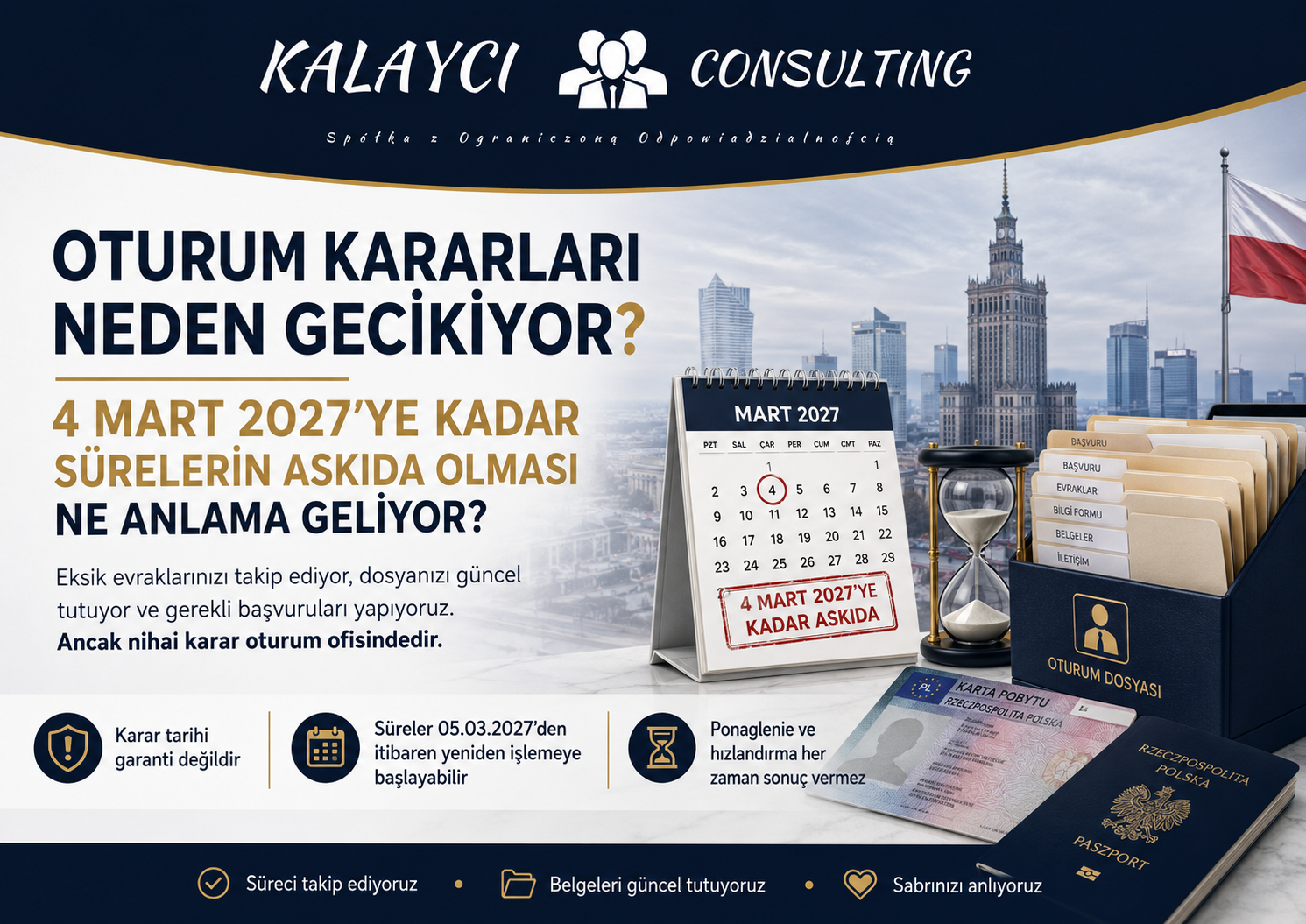
Update — legal status as of 22 August 2026: Article 100d formally suspends specified periods in covered residence proceedings conducted by a voivode until 4 March 2027, but does not prohibit decisions. Current NSA case law and the 2026 RPO–MSWiA position indicate that an administrative court need not apply the provision automatically in every inactivity or excessive-length case, particularly regarding delay after 30 June 2024. The outcome of a reminder or court complaint cannot be guaranteed.
Delays in residence permit applications in Poland, statutory time limits suspended until 4 March 2027, and what advisers can actually do
The question we are asked most frequently by people applying for a residence permit in Poland is now, almost every day, the same:
“Is there any progress on my case?”
“Has a decision been made?”
“The decision date shown on INPOL has passed – why is there still no response?”
“I’ve submitted the missing documents; what else is there to wait for?”
“Can’t we submit a request for expedited processing?”
“If we send a ‘ponaglenie’, will a decision be issued?”
“Will the process be speeded up if we take it to court?”
All these questions are perfectly understandable. This is because the residence permit decision is not merely an administrative document. It is a fundamental document that affects people’s working lives, education, family, travel plans, banking transactions, career changes and all their plans for the future.
It is not easy to wait for months, or sometimes even years, without seeing any concrete progress.
This wait is exhausting not only for the applicants but also for us consultants who are following the cases. We, too, check the systems every day, monitor correspondence, update documents and utilise every possible legal and administrative avenue to achieve a result.
However, due to the current legal and administrative system, there is one truth we must honestly acknowledge:
Even if a case is complete and ready for a decision, the adviser cannot determine when that decision will be made.
The adviser prepares the file, monitors its progress and submits the necessary applications to the authorities. However, the final decision can only be made by the competent immigration department.
Let us first clear up the most significant misunderstanding
It is often claimed in the public domain that:
“Residence permit decisions have been suspended until 4 March 2027.”
is frequently used.
Whilst this statement may be understandable in explaining the issue, it is not entirely accurate from a legal standpoint.
The correct statement is as follows:
The running of the statutory time limits applicable to the finalisation of residence applications has been suspended until 4 March 2027.
This does not mean that the Immigration Office will be unable to issue any decisions until 4 March 2027.
The Residence Office:
- may examine the application,
- request missing documents,
- carry out security checks,
- request further clarification,
- make a positive or negative decision,
- and initiate the process for the preparation of the residence card.
Procedures carried out during this period are valid.
Indeed, in some cases, decisions can still be made swiftly. Some individuals may receive a decision on or shortly after the estimated decision date notified to them.
However, in practice, this is quite rare.
In many cases, no decision is issued for months, even after the estimated decision date shown in the system or notified in writing has passed. In some cases, the silence continues even after more than a year has elapsed since that date.
Under normal circumstances, how long should it take for a decision to be issued?
Under the Aliens Act, under normal circumstances:
- an application for a temporary residence permit must be decided within 60 days,
- within 6 months for an application for a permanent residence permit,
- an application for long-term EU residence should be
are expected to be finalised.
However, this period does not always commence on the day the application is first submitted.
For the 60-day period to commence in a temporary residence case, the necessary procedures generally need to be completed. These include:
- the applicant’s personal attendance,
- the provision of fingerprints,
- rectification of any formal deficiencies in the application,
- the submission of the essential documents required for a decision
are required.
In practice in Mazowieckie, following in-person attendance and the fingerprinting process, an estimated decision date—indicating a time approximately several months in the future—can be viewed in the system or in official correspondence.
However, the practical significance of this date has now diminished considerably compared to the past.
This is because Article 100d of the Special Law on Ukraine suspends the running of the statutory time limits for the immigration offices to finalise residence applications.
Which cases have had their time limits suspended until 4 March 2027?
The provision under Article 100d is not limited solely to applications from Ukrainian citizens.
The provision affects time limits in foreign nationals’ cases handled by the voivode, generally covering the following procedures:
- temporary residence permits,
- permanent residence permits,
- long-term residence in the European Union,
- the amendment of certain residence permits,
- the revocation of certain residence permits.
In other words, whilst the reason for this regulation is the war in Ukraine and the resulting extraordinary migration flows, its consequences are affecting citizens of many different countries.
Whether you are a citizen of Turkey, Georgia, Azerbaijan, India, Uzbekistan, Belarus or any other country, this does not automatically exempt you from this suspension period.
A first-hand statement from the director of the Residence Office
The situation was clearly explained in the official response provided on 8 April 2026 by Małgorzata Łopion, Director of the Department of Foreigners’ Affairs at the Mazowieckie Provincial Office.
The letter contains the following statement:
“The deadline for resolving the matter (…) will commence on 5 March 2027.”
Translation:
“The period set for the finalisation of the case will commence on 5 March 2027.”
The same response states that the relevant statutory time limits did not commence during the period from 1 January 2023 to 4 March 2027, and that any time limits that had already commenced were suspended.
The Director also explains that the administration’s obligation to inform the applicant of its failure to conclude the case within the normal timeframe did not apply during this period.
Consequently, the previously frequently issued notice:
- “Your case will be concluded by this date.”
- “The new decision date has been set as follows.”
- “The reason for the delay is as follows.”
are also linked to the current regulations.
Will all decisions be issued automatically on 5 March 2027?
No.
This is also a significant misunderstanding.
4 March 2027 is the final day on which time limits are suspended under the current regulations.
From 5 March 2027 onwards, it is anticipated that the relevant statutory time limits will begin to run.
This does not mean that decisions will be made on all cases on 5 March 2027.
For example, if all the necessary conditions for a temporary residence application have been met, the standard 60-day period may begin to run from 5 March 2027.
Therefore, the significance of this date is:
“All cases will be concluded by this date.”
but rather,
“Provided the current law remains unchanged, the statutory time limits binding the administration will start to run again.”
is the correct interpretation.
Furthermore, the possibility of the legislation being amended again in the future should not be entirely disregarded. The European Union member states have adopted a new decision to extend temporary protection until March 2028. This decision does not automatically extend the Article 100d period in Poland to March 2028. For this to happen, a separate national legislative amendment must be made in Poland.
Therefore, as of today, the valid date is 4 March 2027. Should any further changes be made in the future, we will provide further information.
Why was this regulation introduced?
The official justification is based on the war in Ukraine.
Following 24 February 2022, millions of people were forced to flee Ukraine. Poland became one of the countries receiving the highest number of people displaced by the war.
This situation:
- temporary protection registrations,
- PESEL UKR procedures,
- social assistance and employment procedures,
- residence permit applications,
- and family and international protection cases
to rise very rapidly.
The government introduced regulations suspending time limits to enable immigration offices to cope with this extraordinary workload.
However, this solution—initially regarded as exceptional and temporary—has been extended over the years.
Today, the problem is not merely the state of emergency during the war’s first months. There is also a more general, long-standing issue of administrative capacity.
The problem is not just the war in Ukraine: systemic overload and staff shortages
The Rzecznik Praw Obywatelskich, or the Polish Ombudsman for Human Rights, has clearly stated that delays in processing residence applications for foreign nationals are a systemic problem that has persisted for years.
According to the Ombudsman’s assessments:
- the number of applications continues to rise,
- there are insufficient staff in the foreign nationals’ departments,
- cases cannot be finalised on time,
- the problem has remained unresolved for years and is growing increasingly serious.
Audits carried out by the Supreme Audit Office have also revealed various irregularities and delays in all immigration offices examined.
The audits revealed:
- cases where no action had been taken for a long time,
- unnecessary delays in processing,
- serious breaches of statutory time limits,
- applications that had been pending for years
were identified.
It is therefore incorrect to attribute the delays experienced solely to a single civil servant, a single adviser or a single applicant.
There is a general and structural problem at play.
Why do cases take longer in Mazowieckie?
Mazowieckie, where Warsaw is situated, is the region in Poland with the highest concentration of foreign residents and economic activity.
In 2025, more than 733,000 applications relating to foreign nationals were submitted across Poland. More than 26 per cent of these came from Mazovia.
In other words, approximately one-quarter of all applications concerning foreign nationals in Poland are concentrated in a single province.
In Mazowieckie:
- a large number of international students,
- foreign workers,
- business owners,
- family reunification applications,
- permanent residence applications,
- long-term EU residence applications
are included.
When the number of staff and administrative capacity are not increased in proportion to this high volume of applications, a backlog of cases becomes inevitable.
Consequently, it is possible for a case that is resolved within a few months in another city to take much longer in Warsaw.
Why is the ‘decision date’ delayed?
The decision date provided to the applicant or displayed in the system often refers to the date on which the case is provisionally scheduled to be concluded.
However, this date:
- is not a guarantee that the decision will definitely be issued on that day,
- does not mean that the card will be printed on that date,
- does not indicate that a favourable decision has been made,
- does not automatically trigger sanctions in the event of a delay in the case.
Pursuant to Article 100d, from the administration’s perspective, this date is currently largely an estimated and organisational one.
Some officials are able to complete their files by the planned date. In some departments, however, the deadline may be exceeded by several months due to workload, staff changes, security checks or the order in which files are processed.
Consequently, the expiry of the decision deadline:
- the adviser has not followed up on the file,
- the documents were never sent,
- the file has been lost,
- the application has been rejected
.
In most cases, this simply means that the file is still awaiting processing at the Immigration Office.
What do we as consultants do with the files?
At Kalayci Consulting, we do not simply submit the initial application and then wait.
The steps we take whilst the application is being processed include the following:
- monitoring official correspondence,
- checking e-Doręczenia, MOS and INPOL notifications,
- responding to requests for missing documents within the specified timeframe,
- updating employment contracts,
- renewing salary and ZUS documents,
- keeping student documents up to date,
- renewing insurance documents,
- notifying any changes of address or employer,
- submission of supplementary explanations to the file,
- preparing an application for expedited processing,
- submitting a request for postponement,
- filing an application with the administrative court where deemed necessary
are included.
The purpose of these procedures is to ensure that the case remains ready for a decision to be made.
This is because, in cases that drag on for a long time, the documents submitted at the time of the application may become out of date over time.
For example:
- an out-of-date employment contract,
- an expired health insurance policy,
- an out-of-date student certificate,
- a change of employer,
- a different salary,
- new address,
- a new passport
may require the file to be reviewed again.
It is therefore extremely important to keep the file up to date throughout this lengthy process.
However, keeping the documents up to date is not the same as ensuring that the official makes a decision immediately.
Why does a request for expedited processing not always work?
In a request for expedited processing, the applicant usually cites:
- need for a business trip,
- family obligations,
- health condition,
- pressure from their employer,
- inability to travel,
- education or business activities
are explained.
These applications may be successful in some cases.
In particular, where there is an exceptional, documented and serious reason, there is a greater likelihood that the case will be processed more quickly.
However, a request for expedited processing does not legally bind the authorities.
Immigration Office:
- the order of the case,
- the status of other applications,
- the urgency of the grounds,
- and whether the case is ready for a decision
can be assessed together.
For this reason, the reason ‘I have been waiting for a very long time’ alone is not always considered sufficient.
Why is a request for expedited processing no longer as effective as it used to be?
Ponaglenie is a legal remedy normally used where the administration fails to conclude a case within the prescribed time limit or unnecessarily prolongs the proceedings.
However, due to Article 100d:
- statutory time limits do not run,
- the application of the provisions on inaction is restricted,
- the administration’s obligation to issue a notice of delay is not enforced,
- and it becomes difficult to achieve an effective outcome based solely on the expiry of the time limit.
For this reason, even if we prepare and send a reminder, we cannot ensure that a decision is issued immediately in every case.
Sometimes, following a reminder, there is movement in the case. Sometimes the case is transferred to another official, or a request for missing documents is sent.
However, in many cases, there is no tangible acceleration in the process.
Is bringing an inaction claim a definitive solution?
No.
Some administrative courts have criticised the provisions of Article 100d in certain cases from the perspective of the Constitution or European Union law and have not applied them to the specific case in question.
This creates a significant legal opportunity for applicants.
However, there is a crucial detail here:
The fact that a court does not apply Article 100d in a particular case does not mean that this provision has been generally repealed.
This point is also clearly stated in the letter from the Director of the Mazowieckie Regional Administrative Court.
The Director states that the ‘scattered constitutional review’ carried out by the courts produces effects only in relation to the specific case under consideration; it is not binding on other judges or other cases.
The letter also states:
“The provisions of Article 100d (…) remain in force and are binding.”
it is stated.
Translation:
“The provisions of Article 100d remain in force and are binding.”
For this reason, applying to the court may be worthwhile in certain specific cases, but it does not guarantee a swift decision in every case.
Even if a favourable outcome is obtained from the court, the court itself does not grant permission to attend a hearing. It requires the Immigration Office to make a decision within a specified timeframe in order for the case to be concluded. According to some rumours, even if an appeal is lodged against the court’s decision, unfortunately no decision is made within the specified timeframes.
Why do we not send the same application form to all our clients every time?
We have observed that letters sent repeatedly with the same content do not always yield a positive outcome.
Indeed, the official reply sent by the WSC Director clearly states that new correspondence with the same content may be left unanswered.
Therefore, sending the same text to the case file every week:
- does not automatically expedite the case,
- does not ensure the immediate appointment of a decision-maker,
- nor does it always lead to a new legal outcome.
We endeavour to assess the most appropriate time and method for each case.
It may be worthwhile to submit a new application if there is a genuine change, a new document, a serious urgency or a legal justification.
However, repeatedly sending the same letter – which is known to be ineffective – simply to provide the applicant with temporary relief is not a professional solution.
Is it correct to say that ‘90 per cent of the time, nothing works’?
There are no official government statistics on this matter.
However, based on our practical observations of the cases we handle at Kalayci Consulting, the following is true:
Requests for expedited processing, ‘ponaglenie’ or similar initiatives do not result in a decision being issued within a short timeframe in the vast majority of cases.
The figure we have expressed as approximately 90 per cent is not an official statistic; it is based on our practical experience with the cases we have been monitoring.
This does not mean that we do nothing.
On the contrary, it demonstrates that, despite carrying out all possible procedures, the authority to make a decision still lies with the Foreigners’ Office.
If the file is complete, who is in charge now?
If the application:
- the application criteria have been met,
- fingerprints have been provided,
- any omissions have been rectified,
- up-to-date employment or education documents have been submitted,
- insurance and financial documents are ready,
- and if official requests have been responded to within the specified timeframe,
then the basic obligations that the consultancy office can fulfil have been met.
After this stage:
The matter is with the Foreigners’ Office.
The adviser:
- cannot get the official to sign the file,
- cannot guarantee that the decision will be favourable,
- cannot determine the date of the decision themselves,
- cannot alter the administration’s internal prioritisation,
- cannot control the response time of security agencies.
We can ensure that the file is ready and that the applicant’s rights are protected.
However, we cannot make a decision on behalf of a government authority.
What should our clients do whilst they wait?
We understand that it is natural to ask ‘is there any progress?’ every day or every week.
However, we inform our clients whenever there is a new document, decision or change in the system.
The most important thing during the waiting period is to keep the file up to date.
Please inform us of the following changes without delay:
- obtaining a new passport,
- a change of address,
- a change of employer,
- leaving employment,
- signing a new contract,
- a change in salary,
- change of school,
- completion of studies,
- marriage or divorce,
- the birth of a child,
- long-term travel abroad,
- expiry of health insurance,
- receipt of an official letter addressed directly to you.
These changes may affect the legal basis of the case.
Being patient does not mean ‘forgetting about the case’
Our call for patience does not mean that cases are not being monitored or that no action is being taken.
We:
- check correspondence,
- respond to incoming requests,
- to keep documents up to date,
- submit requests for expedited processing where necessary,
- assessing legal options
.
However, we do not wish to make unrealistic promises regarding timeframes under the current system.
“A final decision will be issued within a month.”
“Once we submit this application, the case will be settled immediately.”
“If we take it to court, we’re bound to win.”
Such statements are neither professional nor honest.
For every case:
- official,
- department,
- legal basis,
- security clearance,
- document status
are different.
Why does this process exhaust people so much?
The delay in the residence decision is not merely a bureaucratic problem.
Those awaiting a decision:
- may be unable to travel to their home countries,
- may face difficulties when changing jobs,
- may encounter problems with banking or credit transactions,
- may be forced to explain their situation to their employers,
- may not be able to see their families for a long time,
- and may face constant uncertainty.
We do not underestimate the anxiety this causes.
On the contrary, we see the impact of this uncertainty on people every day.
State institutions such as the Ombudsman and the Supreme Audit Office have also pointed out that these delays have serious legal and social consequences for individuals.
Conclusion: We ask for patience, but we are not turning a blind eye to the problem
In the current situation, the main reasons for the delays in session decisions are as follows:
- the very high number of applications,
- staffing and capacity shortages in immigration departments,
- the extraordinary migration burden arising from the war in Ukraine,
- the suspension of statutory time limits under Article 100d,
- a reduction in the pressure on the administration to expedite matters and the risk of sanctions,
- the need to await additional security checks and institutional opinions in certain cases.
As consultants, we are doing everything we can and more.
We prepare cases, rectify omissions, update documents, follow up on correspondence, submit requests for expedited processing, prepare ‘ponaglenie’ and, where necessary, consider legal action.
However, the final decision-making authority lies with the Aliens Directorate.
We therefore ask our clients for a little more patience.
We will contact you should there be any development in your case, should a new letter arrive, or should a decision be made.
We do not wish to keep you waiting or leave your questions unanswered. However, if there are no new developments in the system, there is no new decision or date that we can share with you.
We have not forgotten your case.
We are monitoring the process.
We are keeping your documents up to date.
We are assessing the legal options available.
However, we are not the ones who determine when the decision will be made.
As of today, if the case is ready for a decision, the ball is in the Foreigners’ Directorate’s court.
Kalayci Consulting – This article has been prepared for general information purposes. The legal status of each case and the available avenues of appeal must be assessed on a case-by-case basis.
Legal Basis and Official Sources
- Terminy wydania decyzji w sprawie zezwolenia pobytowego — art. 100d — Podkarpacki Urząd Wojewódzki w Rzeszowie
- Długotrwałość postępowań legalizacyjnych — korespondencja RPO z MSWiA — Rzecznik Praw Obywatelskich