
Student Work Rights in Poland from 1 July 2026
In recent months, one of the most frequently asked questions among foreign students studying in Poland is: "Will I be able to continue working as a student after July 1, 2026?" The answer to this question is no longer as straightforward as it used to be.
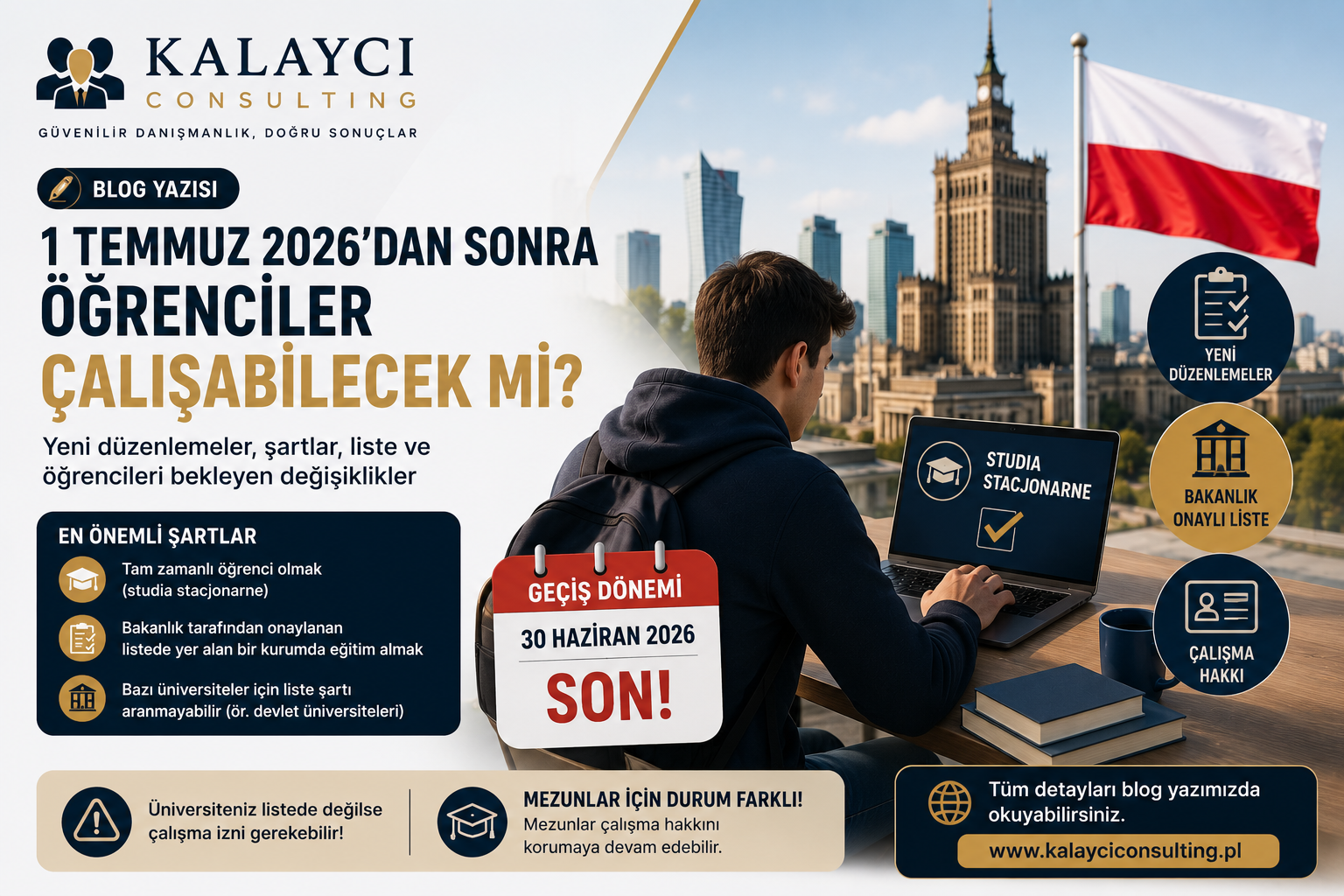
One of the most frequently asked questions among foreign students studying in Poland in recent months is:
"Will I be able to continue working as a student after July 1, 2026?"
The answer to this question is no longer as simple as it used to be.
With the new regulations published at the end of 2025, the rules regarding the working rights of foreign students have changed significantly. Especially the new system, which directly affects thousands of foreigners working with student residence, preserves the working rights of some students while requiring a work permit for some students.
What Changed?
In the past, the general rule was quite simple:
Foreign students pursuing full-time (studia stacjonarne) education in Poland could work without a work permit.
However, this system was changed with the new regulation dated November 20, 2025. Now, being a full-time student alone is not enough. The institution where the student studies must also meet certain conditions.
Who Will Be Able to Work After July 1, 2026?
According to the new rules, to be able to work without a work permit:
✅ Be a full-time student (studia stacjonarne)
and
✅ The institution where you study must be on the Ministry's approved list
is required.
Additionally, some universities and higher education institutions may be considered within scope without legally entering this list. For this reason, each school's situation must be examined separately.
When Does the Transition Period End?
Although the new rules came into effect on December 1, 2025, a transition period was granted to students.
This transition period:
📅 Ended on 30 June 2026.
That is, from July 1, 2026 onwards, the right to work based on student status will not be automatically recognized. Employers will need to check whether the student's school meets the required conditions.
What If My University Is Not on the List?
If the institution where you study does not meet the required criteria:
- you may not have the right to work without a work permit,
- your employer may need to obtain a work permit for you,
- your work arrangement may need to be reorganized.
For this reason, it is important that students and employers conduct the necessary checks now.
Can It Also Affect Student Residence Applications?
Yes.
The new regulations can affect not only working rights, but also student residence processes in some cases.
Particularly, stricter state inspections have started to be applied regarding foreign student admissions.
For this reason, school choice is no longer important only from an educational perspective, but also from a migration perspective.
Different Situation for Graduates
There is an important exception here.
Graduates who have completed their full-time education in Poland generally continue to retain the right to work without a work permit in many cases. The same situation may also apply to those who obtained a doctoral degree in Poland and some other graduate groups.
For this reason, the situation of graduates should be evaluated differently from active students.
What Should Students Do Now?
From 1 July 2026, students should:
✅ Check whether their universities comply with the new rules
✅ Evaluate their work situation with employers
✅ Analyze their residence and working rights in advance
✅ If necessary, research alternative legal working methods
will be beneficial.
Since 1 July 2026, students and employers should verify whether the relevant institution meets the current requirements.
We will continue to share developments regarding student residence in Poland, working rights, and the new regulations.
Employment and the purpose of student residence
A qualifying full-time student may have access to the labour market without a separate work permit. Taking employment does not by itself mean that studies have ceased to be the genuine purpose of residence. Studies must remain the actual principal purpose, student status must continue, and the current 2026 conditions concerning the institution and programme must be met. The individual facts may affect the residence case.
Legal Basis and Official Sources
- Rozporządzenie z 20 listopada 2025 r. — praca cudzoziemców bez zezwolenia — Elektroniczny Dziennik Ustaw (ELI)
- Student — praca bez zezwolenia — Urząd do Spraw Cudzoziemców